
What Does Two-Thirds of All Members of the PH Senate Mean? And What a Difference Two Words Make!
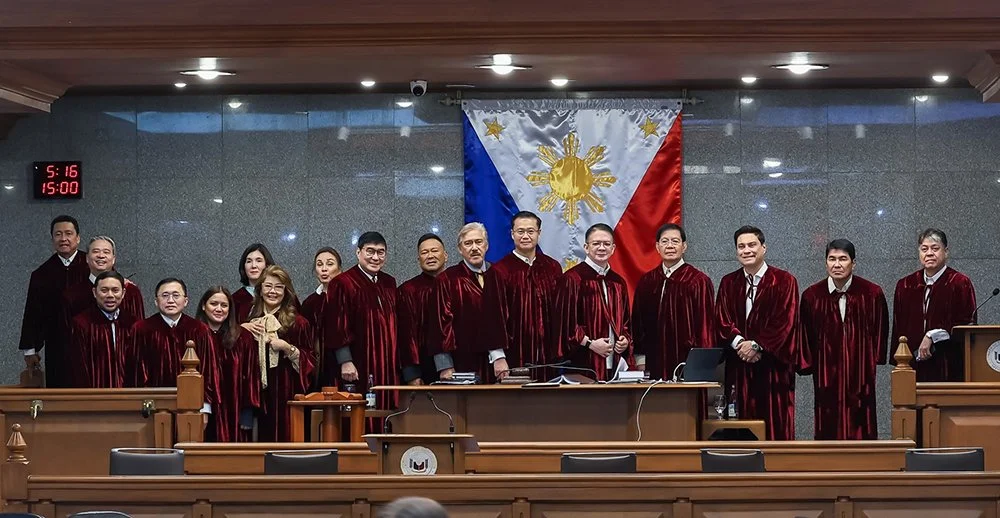
The Philippine Senate in their Oxford crimson robes prior to the impeachment trial of Vice President Sara Duterte (Source: GMA News/Facebook)
Article IX, Section 3, Paragraph 6 of the 1987 Constitution states,
The Senate shall have the sole power to try and decide all cases of impeachment. When sitting for that purpose, the Senators shall be on oath or affirmation. When the President of the Philippines is on trial, the Chief Justice of the Supreme Court shall preside, but shall not vote. No person shall be convicted without the concurrence of two-thirds of all the Members of the Senate.
Based on the language, it seems clear what the required vote is: 2/3 of the 24 members of the Senate – or at least 16 - must vote for impeachment.
However, in view of the peculiar circumstance, legal scholars and former jurists have argued that senators who have not attended the impeachment proceedings should not be counted in the denominator in computing the 2/3 vote requirement.
Prior to the 1935 Constitution, the Philippines did not have a republican form of government. Under the Tydings-McDuffie Act, the drafting, approval, and ratification of a constitution was a key requirement on the path to Philippine independence and self-rule. In drafting the constitution, the 1935 Constitutional Convention likely looked to the U.S. Constitution for guidance, including on the impeachment process.
Article 1, Section 3, Clause 7 of the U.S. Constitution provides,
The Senate shall have the sole Power to try all Impeachments. When sitting for that Purpose, they shall be on Oath or Affirmation. When the President of the United States is tried the Chief Justice shall preside; And no Person shall be convicted without the Concurrence of two thirds of the Members present.
Nonetheless, the drafters of the 1935 Philippine Constitution adopted a slightly different language:
Section 3. The Senate shall have the sole power to try all impeachments. When sitting for that purpose, the Senators shall be on oath or affirmation. When the President of the Philippines is on trial, the Chief Justice of the Supreme Court shall preside. No person shall be convicted without the concurrence of three-fourths of all the Members of the Senate.
The 1935 Constitution made two changes:
· It added “ALL” before the phase “the Members of the Senate;” and
· It omitted “PRESENT” after the phase “the Members of the Senate.”
Did the 1934 delegates, led by Convention President Claro M. Recto intend a stricter and higher bar? Or were these just inadvertent changes?
Since the 1935 Constitution, there have been two others: the 1973 Constitution[1] and the current 1987 Constitution. Both have adopted and carried over the original language. Both constituent bodies let the difference from the U.S. Constitution stand. So, 91 years later, we now ponder the question, what do these words mean?
With respect to the rationale for the 2/3 requirement, a succinct review of the U.S. Constitution sheds light:[2]

The Philippine Senate Building (Source: Brutalist Pilipinas/Instagram)
The English and colonial history thus informed the Framers’ consideration and adoption of impeachment procedures at the Constitutional Convention. In some ways, the Framers adopted the general framework of impeachment inherited from English practice. The English Parliamentary structure of a bicameral legislature—dividing the power of impeachment between the “lower” house, which impeached individuals, and an “upper” house, which tried them—was replicated in the federal system with the power to impeach given to the House of Representatives and the power to try impeachments assigned to the Senate.
Influenced by the impeachment experiences in the colonies, the Framers ultimately adopted an “Americanized” impeachment practice with a republican character distinct from English practice. The Framers’ choices narrowed the scope of impeachable offenses and persons subject to impeachment as compared to English practice. For example, the Constitution established an impeachment mechanism exclusively geared toward holding public officials, including the President, accountable. This system contrasted with the English practice of impeachment, which could extend to any individual save the Crown and was not limited to removal from office, but could lead to a variety of punishments. Likewise, the Framers adopted a requirement of a two-thirds majority vote for conviction on impeachment charges, shielding the process somewhat from naked partisan control. This protocol also differed from the English practice, which allowed conviction on a simple majority vote. In England, the Crown could also pardon individuals following an impeachment conviction. In contrast, the Framers restricted the pardon power from being applied to impeachments, rendering the impeachment process essentially unchecked by the executive branch. Ultimately, the Framers’ choices in crafting the Constitution’s impeachment provisions provide Congress with a crucial check on the other branches of the federal government and inform the Constitution’s separation of powers.
The 2/3 voting requirement was an entirely American creation designed to protect the process from partisan monopoly by the majority. This is consistent with the “checks-and-balances” approach by the U.S. framers.
In the U.S. political context, the Impeachment Clause has been invoked many times. In fact, the very first one involving a federal officer is most informative to the Duterte impeachment trial.
John Pickering, a federal district judge, was impeached by the House of Representatives in 1803 and convicted by the Senate on March 12, 1804. He was accused of drunkenness, blasphemy on the bench. Following debate in closed session, the Senate voted to allow evidence of Judge Pickering’s insanity, drunkenness, and behavior on the bench.
During the trial, objections to the framing of the question at issue caused several Senators to withdraw from the trial. Also, the Senate rejected a resolution to disqualify three Senators, who were previously in the House and had voted to impeach Judge Pickering, from participating in the impeachment trial.
Because of the refusal by some senators to sit as jurors, the 2/3 vote needed was based on less than the full Senate. But since the U.S. Constitution required “concurrence by two thirds of the Members present,” there was no controversy.
In view of the peculiar circumstance, legal scholars and former jurists have argued that senators who have not attended the impeachment proceedings should not be counted.
Given that the origin of the provision dates back to 1934, and the short timeframe given to the 1986 Commission to complete its work,[3] it is unlikely that the drafters of the current Constitution gave it more than a passing thought. Most likely, they surmised the prior language was good enough. After all, if it ain’t broke, don’t fix it. Boy, did we find out! Indeed, in his legal memorandum, retired Chief Justice Hilario Davide, confirmed that there was no debate on the phrase “all members of the Senate” during the deliberations of the 1971 Constitutional Convention and the 1986 Constitutional Commission. Perhaps the next step is to examine the records of deliberations by the 1934 Constitutional Convention for any glimpse of guidance. So, we are back to where we started. What does the following sentence mean? No person shall be convicted without the concurrence of two-thirds of all the Members of the Senate On its face, the addition “ALL” and deletion of “PRESENT” supports the plain reading that the denominator is always 24. The divergence from the more favorable U.S. constitutional language does not – by and of itself - support a situational interpretation based on current events. Ironically, if the 1934 framers simply carried over the U.S. constitutional language, this more expansive reading would be the correct reading. In the end, the controversy could simply be explained and put to rest as “scrivener’s error.” “[A] case in which the words of a legislative text diverge from what Congress meant to say.”[4] That is, a “mistake of expression” as opposed to a lapse of “legislative wisdom.”[5] Otherwise, under the drama of the Duterte proceedings, the impeachment clause is a toothless tiger. Footnotes: [1] Article 13, Section 3 of the 1973 Constitution, states: “Section 3. The National Assembly shall have the exclusive power to initiate, try, decide all cases of impeachment. Upon the filing of a verified complaint, the National Assembly may initiate impeachment by a vote of at least one-fifth of all its Members. No official shall be convicted without the concurrence of at least two-thirds of all the members thereof. When the National Assembly sits in impeachment cases, its Members shall be on oath or affirmation.” (Underscoring supplied.) [2] “Impeachment and the Constitution.” US. Congressional Research Service, CRS Report R45013 (Updated December 6, 2023, p. 17. Footnotes omitted. [3] The 1986 Commission completed its task in five months (June 2 to October 15, 1986). This is about the same period as the 1934 Constitutional Convention which convened from July 30, 1934 to February 19, 1935 [4] Doerfler, Ryan, “The Scrivener’s Error.” Northwestern Law Review, Volume 10, Issue No. 4 (June 23, 2016), p.816. [5] Ibid., at p. 817. Ben R. Olivas, Esq. was admitted to and is a member of the Philippine Bar 1988 (inactive); Admitted to and member of the California Bar (2009). Partner, DLA Piper LLP Silicon Valley (2008 to 2025); Partner, PricewaterhouseCoopers LLP Silicon Valley (1993 to 2008); Associate, Romulo Law Office (1988 to 1991); Ateneo Law School (1988); New York University, Masters in Corporation Law (1992); New York University, Masters in Taxation (1993). Ben retired from DLA Piper this year. He lives in the San Francisco Bay Area.
Final Thoughts




No comments: