
The Strange, the Magical, and the Marvelous
Book Review: Residents of the Deep, by Marianne Villanueva, Unsolicited Press, 2025, 194 pp.
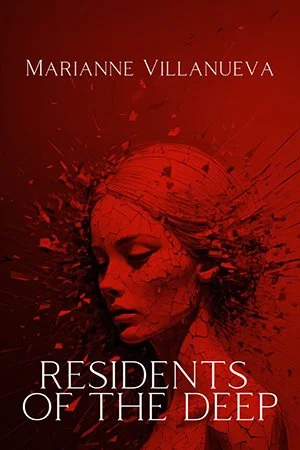
Marianne Villanueva’s latest short story collection, Residents of the Deep, is a work that falls within the lineage of Márquez. The collection comprises twenty-seven short stories, each crafted with acute attention to detail. As Márquez suggests, Villanueva’s fiction takes the hard, raw material of reality and fashions it into otherworldly narratives. Many of the pieces in this collection are flash fiction, spanning only a page or three. Flash fiction, micro-fiction, and what some call postcard fiction demand a heightened sense of urgency. Tension and conflict escalate not just in the opening sentences or paragraph but must be evident from the very first words—and Villanueva immediately draws in the reader, keeping the pace tight and clipped, the pulse racing. Her fiction is what I like to think of as breath-stealers. Her characters, the circumstances they find themselves in, and the moments of tension are all designed to keep your breathing shallow. These tales are well-engineered page-turners.

Author Marianne Villanueva
Villanueva’s fiction picks up where Márquez left off, sharing tales of the tropics, pushing the boundaries of the fantastic, and expertly playing with language to surprise the reader and keep us rapt with wonder. Born and raised in the Philippines, she is now based in the Bay Area and is a Stanford Stegner Fellow. Her third collection, newly published by Unsolicited Press (August 2025), is loosely—and arguably—structured in three acts. We begin with what I like to think of as The Strange, move to The Magical, and close with The Marvelous. Villanueva deftly dips in and out of various literary genres—from speculative fiction to science fiction, fairy tales, historical fiction, and magic realism. The stories in this collection serve as a peripatetic journey, all about movement, transitory people, fleeting moments, and liminal spaces.
The first act, The Strange, begins with “Dumaguete,” told in the third person from the perspective of a young boy, Carlos. Both Carlos and the reader are shuffled to opposite ends, bounced from mother to father, and traverse the length of the Philippines, essentially preparing us for the dizzying shifts that will jolt us from one story to the next. The family members in this opening tale are alienated from one another—a recurring theme that echoes and refracts throughout the collection. Solitude and loneliness reverberate through each character, as we oscillate between the desire to be alone and the weight of being left alone.
The titular story, Residents of the Deep, plunges us into science fiction as the narrator and his crew search for the lost city of Atlantis. The pull of the water and the lure of the mysteries beneath the surface foreshadow the enigmas—and possibly sinister threats—that await in the coming pages. We are drawn further into the strange with the next four interconnected stories, which firmly anchor us in science fiction. Even their titles hint at dystopian futures: Thing, Spore, First Life, and First Causes transport us to post-apocalyptic worlds, from a mutant pig zoo to a laboratory where the sun has burned out and the planets are dying. Climate change has obliterated the world as we know it.
This set of stories poses the most fundamental questions of human existence: What is self-consciousness? How do we know the self? One character reflects on the most essential element of human life: “To the best of my knowledge, love’s a result of a pill or a drug, or an amphetamine. So it can’t be real. Anything produced by a pill can’t be love; it can’t be real.” The characters in these stories are caught in temporal limbo, each seeking something as basic as love, companionship, or the chance to contemplate the color green.
Many of the pieces in this collection are flash fiction, spanning only a page or three.
Villanueva, like her predecessor Márquez, masters the uncanny, the unsettling, the marvelous, and the mysterious. The tale “Flight” evokes Márquez’s enduring short story “A Very Old Man with Enormous Wings.” We encounter a character whose family can fly, though the young narrator has yet to grow into his legacy. He instructs us: “My grandfather taught me. First, he said, one must have air. This is necessary to generate the required lift. Then, the air must churn at a uniform rate. One hundred cycles a minute was the minimum to raise my body two inches off the ground. Third, my grandfather said, one must have optimism, for optimism infects the whole being and renders it light.” No matter how dark the circumstances may be, or how sinister the threats that lurk throughout these stories, Villanueva casts an undeniable light that lends buoyancy both to her main characters and to her readers.
The Strange turns to The Magical, wonderfully rendered in the bittersweet and cheeky story “Samael.” Told with seductive whimsy, a college student is visited by an angel who tries to cure the protagonist’s eternal loneliness. Villanueva vividly maintains the same lightness and buoyancy to carry us from one tale to the next, enchanting and beguiling her readers. “The Essence of Spain,” “The Elephant,” and “Spinning By Candlelight” are fairy tales, with “Spinning By Candlelight” reading like an incantation. The narrator casts a spell, transporting us to a mythic time beyond our bodies, beyond our waking selves. Infatuation as intoxication—the rhythm and lyricism of these stories are nothing short of witchcraft.
Two nearly twinned stories in the middle of the collection explore the strange territory of women aging into invisibility. The main characters in “The Hand” and “Sofia” find freedom in the margins. “The old were residents of another country,” one of the narrators observes, and, like the explorers and adventurers who bookend these two stories, these women seek to answer burning questions: What is life? How do we fill it from birth to death? They plumb the depths of the ordinary in the same way that other characters scout the extraordinary.
Finally, we close with The Marvelous. Villanueva shifts to the past with the intent of illuminating the future. “Don Alfaro & Jose Rizal” is a historical retrospective, examining the ripple effects of the Filipino national hero in contemporary life. Told in epistolary form, “The Marvelous Archipelago” recalls the records of Pigafetta, the Venetian explorer who accompanied Magellan on his circumnavigation. The story oscillates between multiple perspectives, offering an expansive view of history—one of Villanueva’s artful techniques, or “joinery,” as Márquez might call it.
In flash fiction, scale is everything. Time is compressed so that every detail must carry weight. Villanueva’s attention to the minuscule is crystalline. Her imagery and poetic voice scintillate, and her language gets under your skin. “Bridging” serves as the climax, carrying forward prescient themes: souls searching for connection, circumstances rife with injustice, disaster looming—and yet light still penetrates, still manages to propel her characters forward.
Ghosts, angels, and historical heroes and villains haunt these pages. Villanueva takes us to the edge of danger, so that we may contemplate the deep mysteries within us. Her characters force us to question our eagerness for the future when the past still grips our present. Ultimately, she dares us to face the unknown, to stand firm and strong amidst loneliness, darkness, and uncertainty. As one of her characters urges, “Time—the past—tunnels its way into our hearts, there is no way of knowing where all of this will end.”

Rashaan Alexis Meneses teaches in the Writing Studies and Collegiate Seminar Programs at Saint Mary’s College of California. Recently nominated for a Pushcart and Sundress Best of the Net Prize, her fiction and non-fiction have been featured in LitHub, Write or Die Magazine, Kartika Review, Puerto Del Sol, New Letters, and the anthology Growing Up Filipino II: More Stories for Young Adults. When she’s not writing or teaching, she’s hiking and paddling the California coast with her family. Otherwise you can find her at http://rashaanalexismeneses.com/
More from Rashaan Alexis Meneses



No comments: