
PIA Benefit Debuts Film on Larry Ramos, First Fil-Am Grammy Winner

Larry Ramos and The Association sold over 70 million records including six gold records. From “Along Comes Larry.”
Or, in the case of Larry Ramos, who passed away in 2014, they turn up in unexpected places, such as the 1980s quiz game Trivial Pursuit, as the answer to the question: Who was the first Asian American to win a Grammy Award?
The first Filipino—and therefore the first Asian American—to claim a trophy from the United States recording academy, Larry Ramos helped redefine the face of American pop culture. He won his Grammy in 1963 as a member of the popular folk group the New Christy Minstrels—before the Civil Rights Act was passed, and three years before he joined the then-newly formed band The Association, where he co-soloed the mega-hits “Never My Love” and “Windy,” now staples in the pop-rock canon.
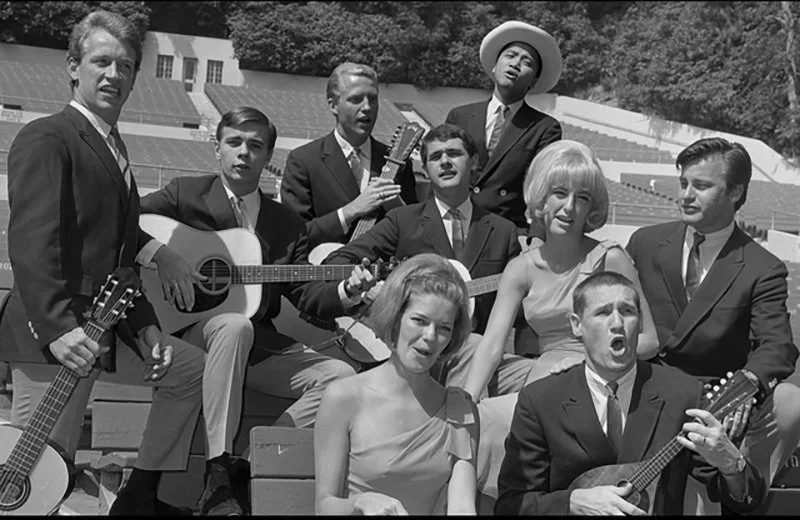
Larry Ramos Jr. (wearing hat) stands out for many reasons with the New Christy Minstrels. Wikipedia
It was quite a feat for the banjo-strumming crooner who broke every stereotype of who and what counted as “American,” and whose heritage was little known outside his birthplace, Hawaii.
Too few knew—even among Fil-Ams diligently monitoring their own in arenas previously verboten to people of color.
But not anymore.
Ramos’ barrier-breaking accomplishments are enshrined in Along Comes Larry: The Larry Ramos Story, a documentary written, directed and produced by Rick Quan, former sports anchor with CBS affiliate KPIX in San Francisco and most recently news anchor with KITV in Hawaii.
Multigenerational Party
Last week, Quan’s tribute was beamed to an SRO crowd in San Francisco for a cause Ramos may never have known about, but whose beneficiaries will always remember him, his bands, and their music.
To celebrate the 39th anniversary of Philippine International Aid (PIA), the humanitarian nonprofit’s leadership reunited The Association for a once-in-a-lifetime San Francisco film-debut-and-concert on Nov. 23 at the Marines’ Memorial Club, a block away from the Philippine Consulate General.
More than 500 people—representing every generation across two centuries—witnessed Association co-founder Jules Alexander, original member Jim Yester, and newer members Larry’s younger brother Del Ramos, Paul Holland, Bruce Pictor, and Gary Swan perform their beloved chart-toppers.

The Association bassist-singer Del Ramos (right) shares anecdote about older brother, Larry, at pre-concert chat moderated by Lloyd LaCuesta (from left) with former news anchor-documentarist Rick Quan and band co-founder Jules Alexander. Photo by CMQM
Alexander announced that his birthday was the next day, when he would turn 86—part of the cohort ironically dubbed the Silent Generation. In the multigenerational audience, pioneer social justice advocate Cynthia Arnaldo Bonta, 88, stood out in her Filipiniana as she clapped and swayed to the music.
Retired SF Superior Court Presiding Judge Ron Quidachay, 78, was among those tapping on their cellphones, helping raise $26,000 in the 10-minute pre-concert live donation drive. So was Eva Alminiana Monroe, 76, past SF Botanical Garden board chair and president, whose late brother, Angelo, owned New Christy Minstrels albums.
Late Boomers Cathy Sebastian Oledan of Foster City and Margarita Veloso Sese of Tracy sang along to their elders’ favorite songs.
For $100 a ticket, guests helped bolster PIA’s programs to educate underprivileged children in the Philippines and gifted students in California. The annual benefit has rescued, rehabilitated, and educated 70,000 Filipino youth, PIA executive director Carlo Abaya, a Gen X’er, proclaimed at the top of the show.
“We want to support future leaders here and continue the legacy of giving back to the Philippines… and transferring students from a California community college to a four-year university,” PIA president James Lim told Inquirer.net USA. He had been unfamiliar with The Association until June, when PIA founder-chair Mona Lisa Yuchengco pitched her idea for this year’s benefit. His daughter later sang an a cappella version of “Never My Love” with her school choir, he added—an experience that endeared the song, and Ramos, to him and his wife.
This year, scholar Beatrice Divina—an officer with the LGBTQ+ club SAGA while at Skyline College and an immigrant-rights advocate with Anakbayan Daly City—is headed to San Francisco State to study speech therapy. Princess Johanna Eusantos, also from Skyline, where she founded Project Hope4Humankind, which has assisted 10,000 unhoused clients, will take up oncology at USC.

PIA president James Lim (left) and board member Lieza Danan (right) commend this year’s scholarship recipients Beatrice Divina and Princess Johanna Eusantos. Photo by CMQM
Past PIA scholarship awardees often attended ceremonies by themselves. This year, they were escorted by their parents, who wanted to enjoy the music of their own teenage years, Lim said.
The awardees may not have The Association on their playlists, and they may be charting paths different from that of the celebrated, departed star of the event, but their destination is the same: the inclusion of Filipino Americans in places where their presence once seemed improbable. Which is why Larry Ramos became the focal point of the organization’s milestone celebration.
Inspirational
Call it the Mona Lisa Yuchengco Effect—the blockbuster outcome of every project undertaken by the philanthropist, who has supported communities on both sides of the Pacific through successful donation campaigns, including this latest endeavor to properly exalt Larry Ramos.

PIA founder and chair Lisa Yuchengco gets congratulations from LGBTQ+ advocate Voltaire Guingab for successful benefit. Contributed.
“We hope that the children we send to school in the Philippines will be successful in completing their education, finding a good job, lifting themselves and their families out of poverty, and contributing to society,” she explained. “Not all of them can be internationally renowned like Larry Ramos, but when they see somebody like Ramos make it, they can also dream about making it.”
She was an Assumption high schooler when The Association’s popularity reached the Philippines.
“‘Cherish’ was often played at our parties, and we eagerly awaited our crushes to dance with us,” Yuchengco, 75, told Inquirer.net USA. She admitted she did not know the band included a Filipino until April, when her husband, Lloyd LaCuesta, received an email from Quan.
LaCuesta—retired KTVU/Fox News Channel 2 South Bay Bureau Chief and perennial PIA events emcee—was born in 1947 in Kauai, where Ramos had first seen the light five years earlier.
Quan had reached out to the couple, inviting them to be associate producers of his documentary on Ramos “since you’re from Kauai and you both are big supporters of projects that bring recognition to Filipino role models and pioneers,” he wrote.
LaCuesta himself was about to graduate from high school when he first noticed Ramos as a New Christy Minstrel “because of his brownness.”
“He looked like me,” LaCuesta exclaimed at the pre-concert conversation with Quan, Alexander, and Del Ramos, who plays bass for the band. Larry’s success inspired him to become a TV news reporter, a career for which he has earned his own accolades.
Still, LaCuesta had no clue about his fellow Filipino/Kauai native’s historic distinction “until the documentary came out.”
Family first
Along Comes Larry: The Larry Ramos Story (fans will recognize the documentary’s title as a play on the band’s rollicking hit “And Then…Along Comes Mary”) took a year and a half to put together, Rick Quan told Inquirer.net USA. He stumbled on the story while doing a segment on the Grammys as a news anchor in Hawaii and instantly recognized its significance. Upon retiring from TV last year, he plunged into production and interviewed Ramos’ welcoming daughters, Tracy and Stacy, in Phoenix, Ariz.
The documentary, which Quan has entered in 10 film festivals, reveals family as central in Ramos’ life. His father, Larry Sr., owned pool halls and taught his namesake to play the uke at the age of four. Larry Jr. practiced on the floor of a hotel gift shop where his mother, Pat Ramos, worked.
When his parents realized his love of music and performing, they nurtured his budding passion by entering him in ukulele contests—which he aced—and in auditions where his captivating smile won him guest stints on TV. They uprooted to the mainland to pursue opportunities for their son’s extraordinary talent.
The elder Ramoses also stressed the importance of education, pulling Larry from the national tour of The King & I, where, at 13, he was understudy for another Filipino, Philippine-born Patrick Adiarte, who played the royal prince. Ramos completed high school in Bell, California, and studied political science at East Los Angeles College and Cerritos College.
Show business soon beckoned anew with an audition for the backup band on The Andy Williams Show. Larry got the callback, though it was allegedly delayed by producers’ concerns about the color of his skin. He proved he was equal regardless, joining the New Christy Minstrels and helping shape their debut album, which went on to win a Grammy and secure Ramos’ early claim to fame.
Family, however, always came first for Ramos.
“He took a flight from the tour to see his newborn twin daughters,” Del Ramos shared, offering an example of his older brother’s devotion to his wife, Helene, and their children, “and rejoined the tour the next day.”
The Larry Ramos Jr. tribute reveals The Association rocker’s love of music and family.
The next time Larry saw the twins was six months later, compelling him to quit the band in January 1966 so he could watch them grow up.
He took session jobs instead. One of these led to him subbing for The Association’s Alexander, who was a taking leave from the band, at a gig at the Cow Palace in Daly City and then at the Oakland Coliseum. That initial stint drew an offer to join the group for a brief tour, which suited his priorities.
Ramos was quick to pick up the pace, learning the songs in a few hours. When Alexander returned, Ramos prepared to move on — but the band refused to let him go, effectively anointing him as a member of the seven-man group. Creative differences reportedly forced him to leave in 1975, but he returned in 1979. Ramos played with the band from then until his final sold-out performance in 2014 in Idaho. He died a few months later, having survived a heart attack in 2011 and having been diagnosed with metastatic melanoma in 2013.
Together, the band sold over 70 million records and earned six gold records, according to the Quan documentary. Their greatest-hits album went double platinum, featuring songs that evoke vivid memories for the many who entered their teens, fell in love, and had their hearts broken for the first time more than half a century ago — and now, for their children, represent the legacy of a proud Filipino American who achieved success by staying true to himself.
Adapted and reposted from the original with permission from the author.

PF Correspondent Cherie Querol Moreno founded ALLICE in 2003 and serves as executive director. For more information, visit www.allicekumares.com.
More articles from Cherie Querol Moreno



No comments: