
Filipinos in Florida, 1900–1940: Labor, Farming, and the Limits of American Belonging
(Photo by Dorothea Lange/Library of Congress)
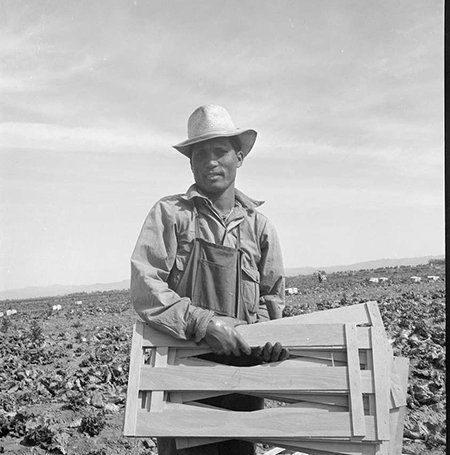
Filipinos entered this world through an unusual relationship with the United States. American sovereignty over the Philippines made them colonial subjects whose legal position differed from that of immigrants from independent Asian countries. Before the restrictions imposed in 1934, their status as United States nationals facilitated migration to the mainland without granting them the full rights of American citizenship. Their movement therefore followed the geography of American power as well as the geography of employment. Education, military service, agricultural recruitment, and personal connections opened routes across the Pacific and within the United States. These opportunities carried expectations of advancement, but they also exposed the distance between American claims of political tutelage and the treatment of Filipinos within American communities.[1]
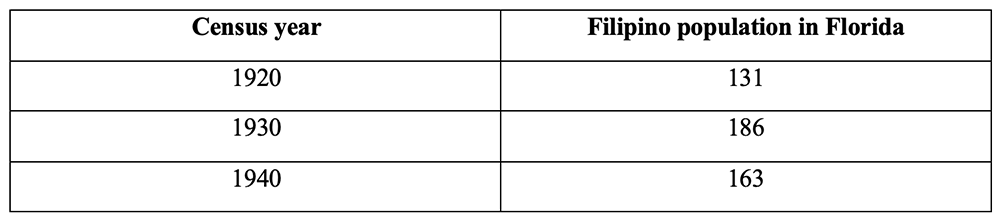
Florida’s census figures show growth during the 1920s followed by a modest decline during the Depression. The population classified as Filipino increased from 131 in 1920 to 186 in 1930, a gain of fifty-five people, or approximately 42 percent. By 1940, the count had fallen to 163, twenty-three fewer than in 1930, a decline of approximately 12 percent. These figures establish a Filipino presence before the Canal Point venture and suggest that the community’s earlier growth did not continue through the 1930s. They count people classified as Filipino under historical census racial categories, rather than only residents born in the Philippines. The statewide totals also cannot measure everyone who worked temporarily in Florida or passed through it between enumerations.[2]
Individual census schedules can connect names with occupations, ages, birthplaces, and household relationships. The 1930 enumeration also included separate merchant-seamen schedules, important for a population connected to maritime work. A person recorded aboard a vessel cannot automatically be treated as a permanent resident of the nearest shore community. Establishing the contribution of naval service requires identifying Filipino personnel in the appropriate military and population records.[3]
Agricultural Workers
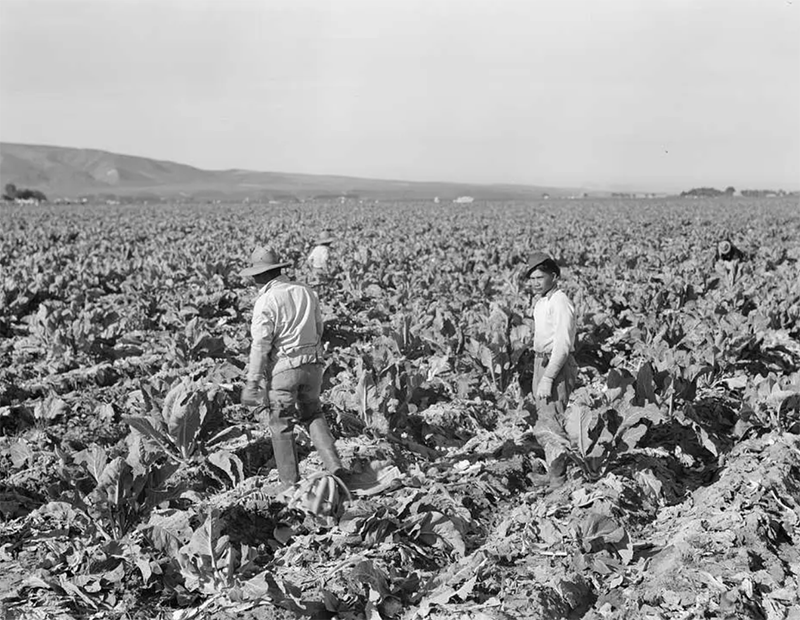
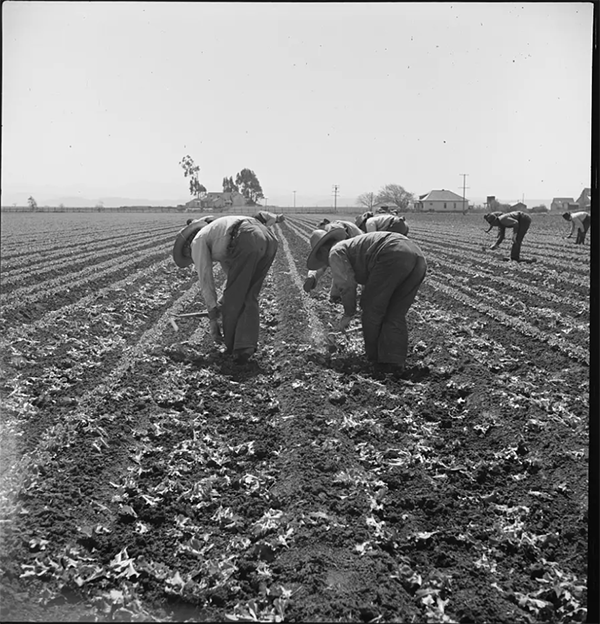
For agricultural workers, Florida offered the possibility of changing their relationship to the land. Moving from wage labor into tenancy or sharecropping could mean assuming greater responsibility for planting, production, and marketing. Such arrangements still involved dependence on landowners, credit, and market conditions, but they could also represent an effort to exercise more control over working life. The distinction matters because the Filipinos who attracted hostility near Canal Point were described in contemporary reporting as farmers with crops awaiting harvest. They were attempting to remain long enough to receive the results of their work. Their expulsion therefore threatened more than a current wage: it threatened an investment of labor in a place they had hoped to make productive.
(Photo by Dorothea Lange/Library of Congress)
Alex S. Fabros, Jr.’s published recollection preserves an account attributed to Julian that connects the Florida venture directly to Salinas. According to that testimony, approximately seventy Filipinos departed California late in November 1930 and reached the West Palm Beach area in December. They obtained farming opportunities, but relations deteriorated as some men associated with white women. Julian remembered threats, departures toward Cuba, and a small group remaining to harvest before returning to California. This account supplies a participant’s perspective on the venture’s beginnings and aftermath. Its numbers and chronology should remain attributed to the recollection, particularly where they differ from the surviving contemporary newspaper report.[4]
Canal Point and nearby Pahokee placed the farmers within the agricultural district around Lake Okeechobee. References to West Palm Beach in newspaper dispatches can obscure this distinction: a dispatch’s dateline does not necessarily identify the scene of the events. The conflict concerned an inland farming settlement whose survival depended upon access to land, the progress of crops, relations with neighboring residents, and protection from local officials.
A July 23, 1932, Associated Press dispatch reported that approximately two hundred white residents had ordered the Filipino colony to leave. Thirty members had departed, while fifteen remained. Pahokee Police Chief F. R. Harrison stated that six could stay until their crops were harvested. The report connected the confrontation to an episode involving a Filipino man and a white woman and to rumors that two thousand additional Filipinos might arrive from California. It also stated that the departing farmers were understood to be heading toward Cuba. The dispatch identifies a location, an official, and an immediate pattern of displacement, although it does not name the Filipino farmers themselves.[5]
Anti-Filipino Hostility
Read alongside the census decline, this newspaper account supports the possibility that anti-Filipino hostility discouraged settlement and drove some residents away. It documents actual departures under pressure, rather than merely expressions of prejudice. Nevertheless, the thirty departures reported in 1932 cannot simply be subtracted from the 1930 census total: the farmers’ residence at the earlier enumeration is not established, and arrivals, births, deaths, and other departures occurred during the decade. Depression unemployment and shrinking opportunities may also have influenced movement. The strongest conclusion is therefore specific: racial intimidation disrupted one documented farming community and may have contributed to Florida’s broader demographic decline, but its statewide effect cannot be calculated from three census totals.[2][5]
The reported arrangement exposes the unequal authority governing the settlement. White residents claimed the power to decide whether Filipino farmers could remain, while the farmers’ agricultural obligations secured only a temporary exception. Permission to finish harvesting recognized the presence of crops without recognizing an enduring right to residence. Read as a labor relationship, the arrangement separated production from belonging: the men could complete useful work, but completion would end their tolerated presence. This interpretation does not require assuming a hidden agreement among every participant. It follows from the terms described in the report. The settlement’s future was being decided through racial pressure rather than through a neutral assessment of whether its members had fulfilled their farming responsibilities.
Harrison presented departure as a means of preventing serious racial trouble. That explanation made removal appear to resolve the emergency while sacrificing the threatened residents’ freedom to remain. The absence of a reported massacre does not make the displacement voluntary. Intimidation could accomplish exclusion without physical destruction, forcing farmers to abandon the possibility of permanent settlement. Canal Point therefore belongs within a history of racial coercion as well as agricultural labor.[5]
The reported involvement of a white woman also requires careful interpretation. The available dispatch does not establish every detail of the relationship or justify treating allegations as proven misconduct. Its significance lies partly in how racial hostility was explained to readers. An individual association became a reason to challenge an entire Filipino settlement. That movement from a personal encounter to collective punishment reveals the breadth of the underlying objection. The issue extended beyond one man’s behavior to the possibility that Filipino men might form relationships, establish households, and become permanent neighbors. A farming community could be economically tolerated while remaining socially unacceptable once its members crossed boundaries that white residents expected them to observe.
(Photo by Dorothea Lange/Library of Congress)
Expulsion
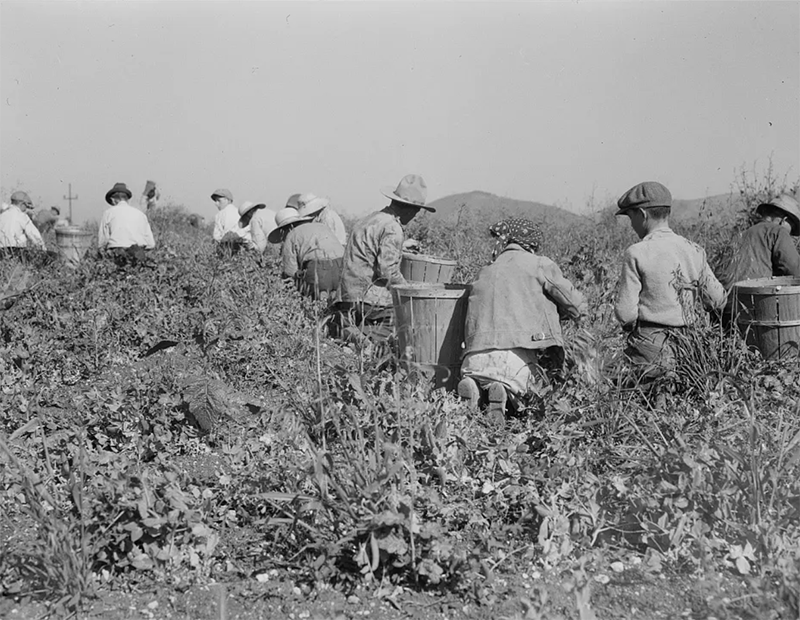
The expulsion likely discouraged further Filipino agricultural migration to Florida. The personal and labor networks that had encouraged movement from California could also carry warnings about threats, forced departures, and insecure access to land. Prospective migrants had reason to question whether Florida offered a dependable alternative to western farm employment. We infer that the destruction of the Canal Point settlement helped interrupt the development of a continuing migration stream of Filipino farmworkers. This interpretation follows from the reported displacement and the venture’s remembered aftermath; it does not establish that no individual Filipino agricultural worker arrived afterward. The rumor that two thousand more Filipinos might come from California reveals contemporary fears about further settlement, rather than proof that such a migration had been organized.[4][5]
Florida’s broader property politics supplied another context for these fears. In 1926, voters approved a constitutional provision permitting restrictions on real property held by aliens ineligible for citizenship. A legal history published by the Florida Bar explains that supporters anticipated Asian farmers moving east after encountering restrictions in California. That history demonstrates that anti-Asian exclusion in Florida could develop in anticipation of migration rather than in response to a large established population. It also shows why the Canal Point episode should be placed within a longer effort to define who could make a permanent claim on the state’s land. The constitutional provision, however, should not automatically be treated as the specific legal instrument that removed these Filipino farmers.[6]
Alfafara v. Fross
The legal distinction between an alien and a noncitizen national is particularly important. In Alfafara v. Fross, decided in 1945, the California Supreme Court held that a Filipino national did not fall within California’s alien-land prohibition merely because he lacked American citizenship. That later California judgment did not decide the Canal Point controversy, but it demonstrates the danger of assuming that every racial restriction applied identically to Filipinos. A precise historical explanation must distinguish statutory disability from intimidation and informal exclusion. Farmers could lose the practical ability to occupy land even when the legal basis for denying them property rights was uncertain or inapplicable. Social power could close opportunities without first obtaining a definitive judicial ruling.[7]
Education provides another necessary dimension of Filipino migration during this period. The federal government’s Directory of Filipino Students in the United States, published in 1922, records students pursuing medicine, engineering, agriculture, commerce, law, and other fields across the country. It establishes the breadth of educational migration, although it does not by itself establish a named Filipino student community in Florida. The distinction prevents a national pattern from being mistaken for a documented local enrollment history. Nevertheless, the educational movement belongs in Florida’s historical framework because it challenges the assumption that early Filipinos possessed only agricultural ambitions. Their migration included aspirations toward professional training, technical knowledge, and public service.[8]
(Photo by Dorothea Lange/Library of Congress)
Filipino Population Growth
United States Navy service offers a plausible contributing explanation for Florida’s Filipino population growth during the 1920s. President William McKinley authorized the enlistment of up to five hundred Filipinos in the Navy’s Insular Force in 1901, connecting Filipino recruits to American naval employment before World War I. Assignments aboard ships and at shore establishments could bring men to Florida and create opportunities for later residence. We infer that these movements probably contributed to the increase from 131 Filipinos in 1920 to 186 in 1930, although the statewide totals cannot identify how many additional residents were sailors, veterans, or civilians. Naval employment and agricultural migration must therefore be considered together when explaining the state’s small Filipino population.[2][9]
World War I widened the geography of service. Five Asiatic Fleet destroyers—Bainbridge, Barry, Chauncey, Dale, and Decatur—left Cavite on August 1, 1917, and reached Gibraltar on October 20. Their transfer demonstrates a route from the Philippines into Atlantic and Mediterranean operations. It does not establish that these ships subsequently brought Filipino crews to Florida. Connecting individual sailors with Florida requires crew lists, service histories, and census matches.[11]
Pensacola provides the strongest institutional setting for this interpretation. The former Pensacola Navy Yard became the site of the Navy’s first permanent naval air station in January 1914. Its continuing operation supplied a setting in which Filipino naval personnel could have entered Florida through assignments and support work. Between 1935 and 1939, the station expanded facilities for aviation mechanics and aviation medicine. These developments identify a sustained source of naval activity, rather than a brief wartime presence. They strengthen the inference that naval service contributed to Filipino residence in Florida, while leaving the number and occupations of Filipino personnel at Pensacola to be established through station records. The presence of an aviation training establishment should not itself be taken as evidence that Filipino sailors trained as pilots.[12]
Key West and Miami supplied additional naval connections. Naval Air Station Key West began in 1917, supplementing the older naval establishment. Its activity contracted after World War I, and the naval operating base entered caretaker status in 1932, before renewed activity as another war approached. Miami’s Dinner Key also became a naval air station in 1917. These installations identify possible points of arrival or assignment, but their changing operations caution against assuming continuous expansion everywhere. Naval Air Station Jacksonville, commissioned in October 1940, belongs to the next phase, after that year’s census enumeration. Mayport’s December 1942 commissioning falls outside this essay’s period. Neither installation explains the population increase of the 1920s.[13]
Other employment must likewise be established through individual records. Ports, hotels, restaurants, and private households offer places to investigate Filipino work; their existence does not prove a Filipino workforce in every Florida city. Directories, census schedules, employment files, and newspaper notices can distinguish permanent residents from seasonal workers, sailors, and travelers.
Tydings–McDuffie Act
Federal policy made the prospects for community growth more restrictive after 1934. The Tydings–McDuffie Act initiated the transition toward Philippine independence while imposing an annual immigration quota of fifty and treating Filipinos as aliens for immigration purposes. That change narrowed the possibilities for new arrivals and complicated the relationship between colonial allegiance and mainland access. For small communities, immigration restrictions affected more than population totals: they limited the potential arrival of relatives and prospective household members. The promise of eventual national independence thus developed alongside a contraction of opportunities to enter the United States. Florida’s fragile settlements faced their local difficulties within this changing national framework.[10]
By 1940, Florida’s Filipino history reflected both continuing connections and opportunities curtailed.
By 1940, Florida’s Filipino history reflected both continuing connections and opportunities curtailed. Naval institutions could sustain movement into the state even as racial intimidation discouraged agricultural settlement. Departures toward Cuba placed the displaced farmers within a wider Caribbean geography; their experience did not necessarily end in an immediate return to California or the Philippines. A declining statewide population could therefore conceal different experiences among sailors, students, civilian workers, and farmers. Filipinos in Florida between 1900 and 1940 should therefore be remembered as people pursuing several forms of advancement under unequal conditions. Farmers sought the returns from land they cultivated; students pursued knowledge and professional futures; naval personnel entered a service shaped by America’s Pacific empire. The surviving evidence is uneven, but the central historical relationship is clear. Opportunities to work and move did not ensure protection against exclusion or acceptance as permanent residents. At Canal Point, the right to finish a crop proved stronger than the right to remain after harvesting it. That distinction captures the precarious place Filipinos occupied in an America willing to benefit from their labor while resisting their efforts to build enduring lives. Endnotes 1. United States House of Representatives, History, Art & Archives, “The Philippines, 1898–1946,” in Asian and Pacific Islander Americans in Congress. 2. Campbell Gibson and Kay Jung, Historical Census Statistics on Population Totals by Race, 1790 to 1990, and by Hispanic Origin, 1970 to 1990, for the United States, Regions, Divisions, and States, Population Division Working Paper No. 56 (U.S. Census Bureau, September 2002), Tables C-7, C-8, and C-9, Florida rows. https://ift.tt/qBwv5LX. 3. United States Bureau of the Census, Fifteenth Census of the United States, 1930, population and merchant-seamen schedules; collection description, FamilySearch. 4. Alex S. Fabros, Jr., “The Ilocano Gang of Salinas Valley,” Positively Filipino, October 9, 2024, especially the account attributed to Julian. 5. Associated Press, West Palm Beach dispatch, July 23, 1932, reproduced in the digitized Pampa newspaper collection, Southwest Collection/Special Collections Library, Texas Tech University. 6. “Amendment 11: Property Rights; Removal of Obsolete Provision; Criminal Statutes,” The Florida Bar Journal, 2018. 7. Alfafara v. Fross, 26 Cal. 2d 358, California Supreme Court, May 22, 1945. 8. United States Bureau of Insular Affairs, Directory of Filipino Students in the United States (Washington, DC: Government Printing Office, 1922). 9. United States Navy, Bureau of Naval Personnel, “Filipinos in the United States Navy,” October 1976, Naval History and Heritage Command, background section; William McKinley, executive order authorizing Filipino enlistment in the Insular Force, April 5, 1901, The American Presidency Project. https://ift.tt/swcqN2u; https://ift.tt/UHhgGxT. 10. Philippine Independence Act, commonly called the Tydings–McDuffie Act, March 24, 1934, 48 Stat. 456, especially section 8; National Archives, “Immigration from Asia and the Pacific, 1870s to 1950s.” 11. Naval History and Heritage Command, “United States Navy and World War I: 1914–1922,” entry for October 20, 1917; Dictionary of American Naval Fighting Ships, “Decatur II (Destroyer No. 5)” and “Bainbridge II (Torpedo-boat Destroyer No. 1).” https://ift.tt/zS9DlIN; https://ift.tt/64lWRKP. 12. National Park Service, “Pensacola Naval Air Station Historic District”; National Naval Aviation Museum, “Naval Aviation Arrives in Pensacola.” https://ift.tt/Es4jFw1; https://ift.tt/UgloLEb. 13. Commander, Navy Region Southeast, “History,” NAS Key West, NAS Jacksonville, and Naval Station Mayport; United States Coast Guard Historian’s Office, “Air Station Miami, Florida.” https://ift.tt/YZKqxpF; https://ift.tt/apTD0ef; https://ift.tt/WzjtK75; https://ift.tt/8tnc2DV. Bibliography Associated Press. West Palm Beach dispatch concerning Filipino farmers near Canal Point. July 23, 1932. Digitized Pampa newspaper collection. Southwest Collection/Special Collections Library, Texas Tech University. California Supreme Court. Alfafara v. Fross. 26 Cal. 2d 358. May 22, 1945. Commander, Navy Region Southeast. “History.” Naval Air Station Key West; Naval Air Station Jacksonville; Naval Station Mayport. Fabros, Alex S., Jr. “The Ilocano Gang of Salinas Valley.” Positively Filipino. October 9, 2024. Florida Bar Journal. “Amendment 11: Property Rights; Removal of Obsolete Provision; Criminal Statutes.” 2018. Gibson, Campbell, and Kay Jung. Historical Census Statistics on Population Totals by Race, 1790 to 1990, and by Hispanic Origin, 1970 to 1990, for the United States, Regions, Divisions, and States. Population Division Working Paper No. 56. U.S. Census Bureau, September 2002. Tables C-7, C-8, and C-9. McKinley, William. Executive order authorizing Filipino enlistment in the Navy’s Insular Force. April 5, 1901. The American Presidency Project. National Archives. “Immigration from Asia and the Pacific, 1870s to 1950s.” National Naval Aviation Museum. “Naval Aviation Arrives in Pensacola.” National Park Service. “Pensacola Naval Air Station Historic District.” Naval History and Heritage Command. “Decatur II (Destroyer No. 5)” and “Bainbridge II (Torpedo-boat Destroyer No. 1).” Dictionary of American Naval Fighting Ships. Naval History and Heritage Command. “Filipinos in the United States Navy.” Naval History and Heritage Command. “United States Navy and World War I: 1914–1922.” Entry for October 20, 1917. United States Bureau of Insular Affairs. Directory of Filipino Students in the United States. Washington, DC: Government Printing Office, 1922. United States Bureau of the Census. Fifteenth Census of the United States, 1930. Population and merchant-seamen schedules. United States Coast Guard Historian’s Office. “Air Station Miami, Florida.” United States Congress. Philippine Independence Act. March 24, 1934. 48 Stat. 456. United States House of Representatives. History, Art & Archives. “The Philippines, 1898–1946.” In Asian and Pacific Islander Americans in Congress. Alex S. Fabros, Jr. is a retired Philippine American Military History professor. Michelle S. Fabros is a professor of psychology at Fresno City College. More articles from Alex Fabros, Jr.




No comments: