
She Found Art in an Attic
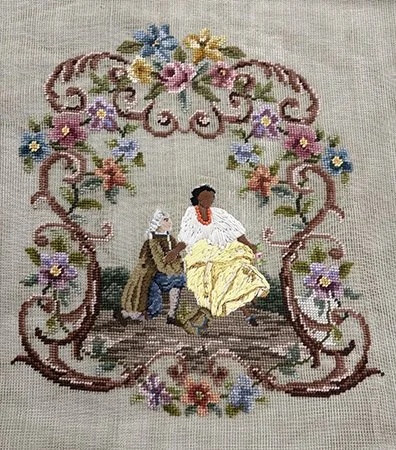
Maria Makiling, 2026
22” x 21.75”
Wool, stranded cotton beads on aida cloth
(photo courtesy of the artist)
The posh kits contained exquisite yarns and wools and a pedigree dating to the Victorian period (1837 to 1901, the reign of Queen Victoria), when suitable maidens were as skilled with the loom as they were at the klavier. Today’s knit and crochet kits, with their detailed instructions and rudimentary tools, are the banal stepchildren of these refined tapestry kits, which are like puzzles with an illustration of the desired outcome and just a few words of guidance. Williams links the social class affiliation less with nobility than with the virulent imperialism of Spain (333 years), the United States (48 years), and Japan (three years), which largely erased indigenous culture in the Philippines.
Respecting the Art
At age 14, Williams accompanied her parents, Remedios and Eduardo Briones, from Capas, Tarlac, to Los Angeles. She worked nearly 20 years as a graphic designer in the in-house marketing department of American Honda Company in Torrance, California, before earning her BFA at California State University, Long Beach, in 2013.
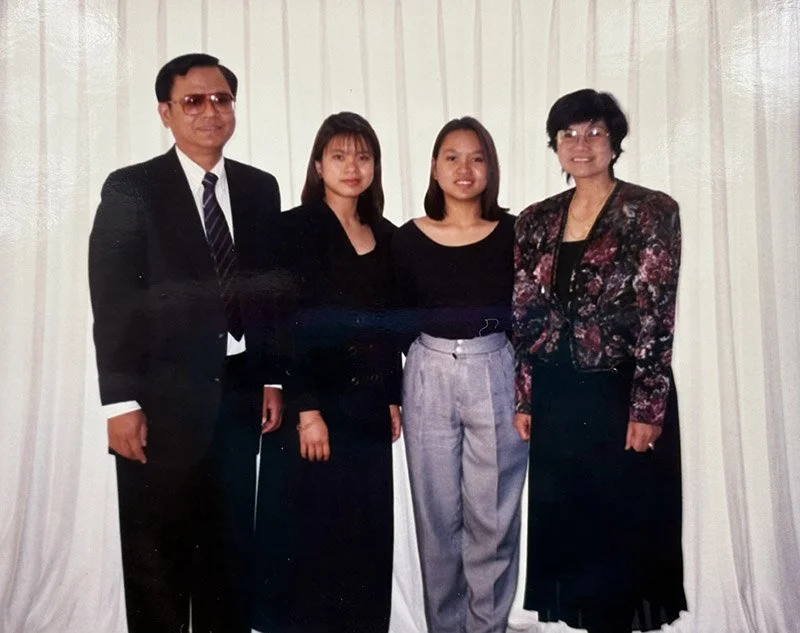
Diane Briones Williams with family circa 1992
from left: Ed Briones, Anne Matining, Diane Briones Williams, Remy Briones
Paintbrushes were the primary instruments in her career, but she was always partial to needlepoint. Her interest in textile art began with sewing lessons from her grandmother in the Philippines. Even though she was inspired by master weavers in the Philippines, she never incorporates their techniques into her pieces out of respect for their artistry, which seldom generates a living wage by American standards.
“It’s in their blood,” she explains. “Weaving is intergenerational for all genders in the Philippines. Families of weavers are excellent.”
It is not cultural appropriation when Jo Koy mocks his mother’s accent or when Fil-Ams copy patterns from Filipino crafts. Williams implies that plagiarizing Third World artisans, who struggle to feed their families, is a moral offense.
“When I go to the Philippines, I make it a point to buy woven textiles. When I select a textile, I pay whatever they ask because I know how labor-intensive it is.”
Listening to her advice while shopping for gifts and souvenirs at bazaars overseas could help resuscitate Americans’ greatly diminished reputations.
Affluence and Apparitions
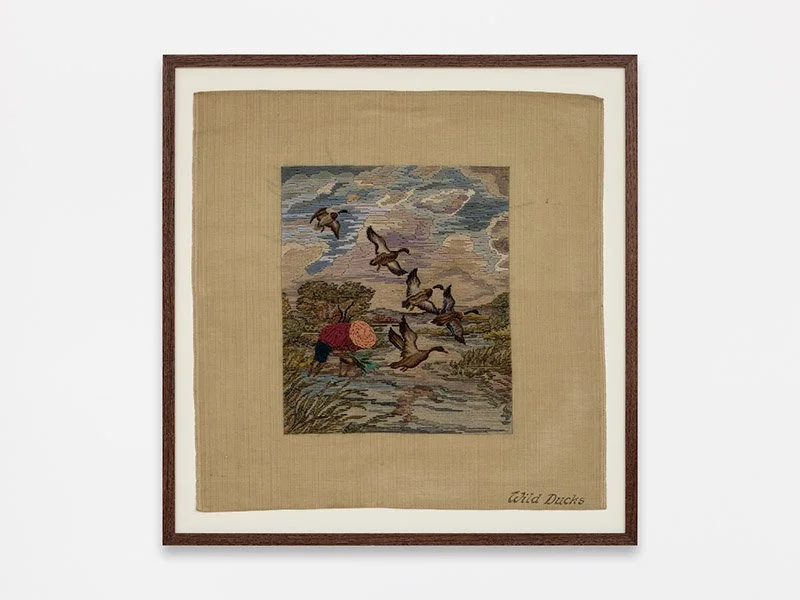
Rice Farmer, 2025
25.5”x25”
Wool on aida cloth
(photo courtesy of Official Welcome)
Williams has ample facility with textiles to duplicate the illustrations on her kits, and for the most part, she follows the designs before embedding ghostly iconography from indigenous and agrarian communities of the Philippines. “Spectrals” is what she calls these victims of colonization who trespass into verdant scenes that originally wiped away all traces of Western hegemony.
In her own words: “Colonization is a ghostly process. It transforms native people and cultures into lingering shadows that continue to haunt the descendants of both colonizers and the colonized. This project, which combines found tapestry kits of Western landscapes merged with Philippine imagery, explores the unique power of these figures and deepens our understanding of the postcolonial experience.”
No country is more hospitable to ghosts than the Philippines. We put the “super” in superstition. Nothing goes bump in the night because our ghosts are agile. These ethereal beings are quite serious to Williams.
For her Spectrals exhibit at Future Fairs in New York City, Williams expanded on the colonization theme in her tapestries. “Within this framework, two recurring spectral archetypes emerge: the native seeking recognition and the ghost of the colonizer burdened by historical guilt,” she states.
A living artist can articulate exactly what she was thinking and eliminate the kind of conjecture that leads deceased artists to a second death. Equipped with an MFA in Visual Arts from the University of Southern California, Williams will probe the ideas that inform her creativity, if asked.
To comprehend her work, there’s no need to be versed in Hegel, Marx, Lennon, or McCartney, but a little philosophy can help. Williams is fluent in Deconstruction Theory as propounded by French philosopher Jacques Derrida.
Some of us were exposed to the ruminations of Derrida in graduate school. In her conversation with me, she was insistent on not corrupting the viewer’s experience with esoteric baggage.
Excited by the Mundane
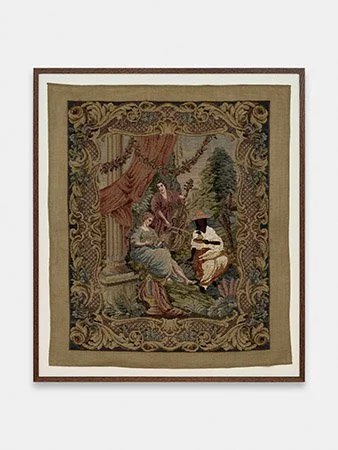
Diwata, 2025
39.75” x 33.75”
Wool and stranded cotton on aida cloth
(photo courtesy of Official Welcome)
None of us visit art galleries for an adrenaline rush sparked by intergenerational trauma inflicted on the Philippines by the Spanish Empire and U.S. Presidents William McKinley and Theodore Roosevelt. Williams’ needlepoint accomplishes more than engaging the intellect. Her textile compositions stimulate the medial orbitofrontal cortex, the region of the brain where, Google AI claims, people “experience beauty in art, music, faces, or mathematics.”
“My work isn’t intended to be didactic,” she says. In art workshops throughout Los Angeles, she focuses on buoyant objects that transport students into Philippine history.
“I have an art series on Spanish galleons,” she says of the marine vessels that conducted trans-oceanic trade to finance the Spanish Empire. “I explain galleons by tying them to concepts my students understand. I ask them whether they know why there were so many pirates back then. It was because galleons carried gold.”
Only the type of individual Woody Allen called a “pedantic pseudo-intellectual” in Midnight in Paris would turn Santo Niño dolls into enigmas. Williams is fond of inserting the ornately robed baby Jesus into her tapestries because he’s a familiar blessing encased in glass on the mantels of Filipino living rooms.
Spain planted Christianity in the Philippines. Filipinos put a passionate spin on the imported faith, exactly as Jesus advised: “I know about your activities: how you are neither cold nor hot. I wish you were one or the other, but since you are neither hot nor cold, but only lukewarm, I will spit you out of my mouth.” (Revelation 3:15–16)
Only Filipinos know why they love Santo Niño more than lumpia. Williams uses emotional overload to save the souls of skeptics. “Filipinos love babies, but not everyone else loves babies. Baby Santo Niño is cute, so let’s dress him like an adult.”
There’s no record of how Mary dressed Jesus after the manger. After all Filipinos have endured, they deserve artistic liberty.
You Say Daster, I Say Duster
Private individuals, museums, and corporations collect her art, but what does she collect? Americans say dusters; Filipinos say dasters. They are both names for the loose dresses made of flowy fabrics worn by Filipinas.
“I’ve been collecting dasters from Filipino family and friends for over two years. The real ones have batik embroidery. The mass-produced dasters have printed flowers. The work is so personal to me because I know where they came from,” she relates. “Since the dresses have histories, it’s like putting together an archive of their stories.”
“Colonization is a ghostly process. It transforms native people and cultures into lingering shadows that continue to haunt the descendants of both colonizers and the colonized.”
She elaborates, “I have dasters from my aunt and a neighbor who died five years ago. They wanted to donate them to me because I can keep their stories alive.” Dasters aren’t as unusual as adult clothing tailored for baby Jesus, but they both satisfy a longing for connection. Note: I recently interviewed Isa Briones from The Pitt. So when I was first contacted by Diane’s manager, I assumed Isa had referred her because they both have Briones in their names. Briones isn’t as common a surname in the Philippines as Marcos or Romuáldez. Diane and Isa aren’t related, nor have they ever met. Now, they have Positively Filipino in common. Spectrals starts its West Coast run with an opening reception from 5 p.m. to 7 p.m. on June 13, 2026, at Official Welcome in The Granada Building, 672 S. La Fayette Park Place. The show remains on view through July 25. The gallery is open from noon to 6 p.m., Thursday through Saturday. Events are free and open to the public. Anthony Maddela is a staff correspondent situated in Los Angeles. He comes from Seattle, and, against all logic, he still hasn’t traded his loyalty to the Mariners for the Dodgers. More articles from Anthony Maddela




No comments: