
Rebuffing Graciano Lopez Jaena’s ‘Dirty Fingers’
Book Review: Graciano’s Dirty Fingers by Emmanuel Lerona. Friends of the University of the Philippines Visayas High School (UPVHS) Foundation.
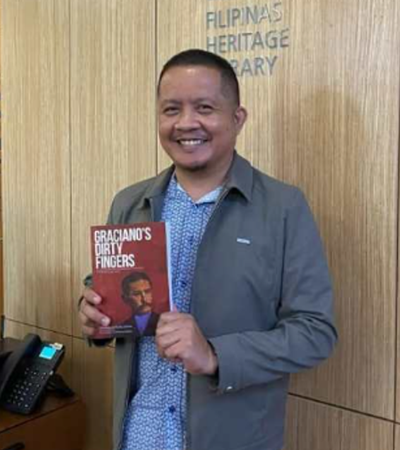
Emmanuel Lerona with his book "Graciano's Dirty Fingers"
In Joaquin’s recounting, Graciano was a “coward” with a “complete indifference to Philippine affairs,” whose speeches were full of “empty rhetoric and floridity.” It gets even more personal: Graciano was a “dirty, disheveled and slovenly” hippie who ate sardines with his fingers and wiped his oily fingers on his clothes.
Nick Joaquin drew heavily from accounts by Jose Alejandrino (1870-1951), whose book, The Price of Freedom, published in 1949, revised after a Spanish original published in 1933, became the basis for many subsequent depictions of Graciano. Alejandrino was in Spain at the same time as Graciano, and his mocking descriptions of Graciano have been taken to be eyewitness accounts – including by historians John Schumacher, Jose Victor Torres, and Resil Mojares.
In fact, Alejandrino and Graciano had limited contact, as a new book, Graciano’s Dirty Fingers by Emmanuel Lerona, spells out. Bolstered by painstaking research, Lerona states: “The divergent locations of the two personalities’ circumstances make it implausible for Alejandrino to have directly witnessed Graciano’s activities. Given their limited contact, it would have been impossible for Alejandrino to base (the) description of Graciano as a “dirty” colleague on direct observation.” Alejandrino’s accounts are likely, Lerona says, to have come from secondhand accounts, hearsay, or rumor.
A Fixed Caricature
Lerona does not stop there. He inquires: “How does a historical figure become so fixed in caricature?” The answer, Lerona says, “lies not only in the bias of individual historians but in how the archive itself, the collection of documents, the choices about what survives, the authority of those who interpret it, shapes what can be remembered and how.” He posits that a Graciano with “dirty fingers” is an image that was perpetuated by “a colonial elite confronted with a hero who did not conform to bourgeois ideals of civility and propriety.” And he proceeds to reconstruct for us, based on rigorous research that included a trip to Spain, Lopez Jaena’s unlikely, but most definitely heroic, journey from very humble beginnings in Jaro, Iloilo, to being the clarion voice of a nation waiting to be born.
Lerona started his Graciano project in September 2023. Retired Supreme Court Justice Francis Jardeleza, prime mover and shaker behind the Friends of the University of the Philippines Visayas High School (UPVHS) Foundation, approached Lerona, at the time a lecturer at the University of the Philippines in the Visayas, to see if he would be interested in “redeeming Graciano.”
This was an effort that had already been kicked off by UPVHS alumnus Francisco Villanueva, who, while traveling in Spain and working on his own book, Bugasong to Barcelona: Life and Works of Felix Laureano, had come across and been alarmed by the largely negative portrayal of Graciano in history books and the lack of information on his activities in Spain. Lerona took on the challenge, dusting off church records, going in search of Graciano’s descendants and other possible informants, and using his formidable skills in technological research to access records of libraries and archives not just in the Philippines, but also in Spain, where a few librarians supported his efforts.
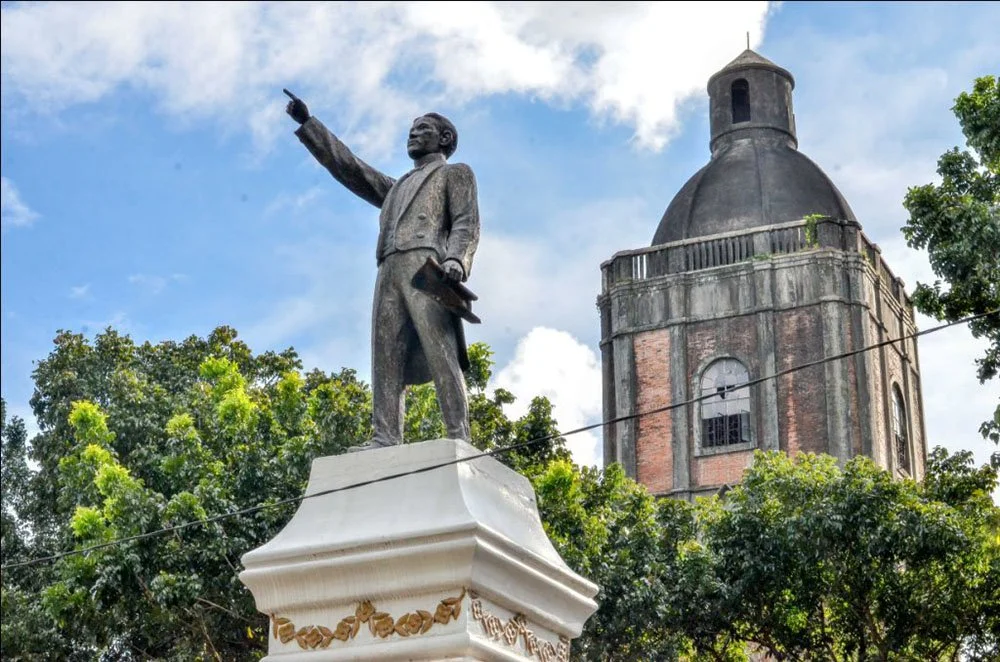
Graciano Lopez Jaena monument in Jaro, Iloilo City, where he was born.
Sprawling Book
The result is Graciano’s Dirty Fingers, a sprawling book that begins with a review of Spanish rule in the Philippines, including elements like the encomienda system, reduccion, mercantilism and the galleon monopoly, and the eventual waning of Spanish influence and power. It then takes us to Iloilo, a thriving port city, flush with the proceeds of the textile industry and later, the sugar trade, and its municipality of Jaro, a commercial and ecclesiastical center where an enterprising bishop, Mariano Cuartero, built an imposing cathedral and established a seminary where Graciano would receive a basic education.
With this background, Lerona then follows Graciano’s footsteps from Valencia where he enrolled as a medical student, to Madrid where he first came to be recognized as a gifted writer and fiery orator, and then to Barcelona where he found the fullest expression of his revolutionary ideals and where he died at the very young age of 39.
“By the time Graciano was born in 1856, Iloilo had already been transformed into a thriving commercial hub.” Families that profited from the economic boom sent their children to Manila and/or Europe for further education and cultural exposure. It was these students and their counterparts from other provinces who – exposed in the continent to ideas of nationalism and reform – would go on to found the Propaganda Movement in Spain. Unlike these children of the wealthy and the powerful, Graciano was able to go to Spain with limited funds provided by a distant relative. In Spain, penury was never far from his door.
‘Fray Botod’
Graciano had already achieved some notoriety before he left for Spain, with the distribution of his satirical piece about a dissolute Spanish priest whom he named “Fray Botod” – or the priest with the bloated stomach. His departure for Spain was partly to evade harassment by authorities, but he was also spurred by dreams. He believed Spain would offer the opportunity for him to speak more freely, and he hoped to find support for his ideas for colonial reform there.
Even in his early days in Madrid as a transferee to the medical studies program at the Universidad Central, Graciano’s writing shone. The Gaceta Universal wrote of him: “What a great pity that Mr. Graciano Lopez dedicates himself to medicine, having such enviable talents for literature!” He joined the Circulo Hispano Filipino, one of the earliest organizations formed by Filipinos in Spain, and wrote articles for its paper, the Revista (the equivalent of today’s “review” or “journal”). Among his early articles was an urgent plea for educational reform in the Philippines. In 1883 Los Dos Mundos published in full his article titled “Una Protesta,” a rebuttal of the depiction by writer Valentin Gonzalez Serrano of Filipinos as indolent.
Before long Graciano was giving speeches at prestigious lecture halls and intellectual gatherings, including the Congreso Espanol de Geografia Colonial y Mercantil, the Teatro Real and the Fomento de las Artes. After a speech he gave at the Congreso Espanol de Geografia Colonial y Mercantil Odon de Buen, who would go on to found the Spanish institute of Oceanography, wrote: “…..the young Filipino Graciano Lopez exposed the harmful influence exerted by religious teaching based on religious doctrine; because he carried the voice of a people, he spoke with the sincerity of someone asking for a right on behalf of his fellowmen and drew inspiration from the true principles of civilization.”
And then there was La Solidaridad. Fernando Canon, a contemporary of Graciano, Marcelo del Pilar, and Mariano Ponce in Barcelona called Graciano the “chispa,” the spark behind the newspaper. “He was the author, the initiator, the godfather…Because from his lips came forth the name La Solidaridad.” Interestingly, later historians would come to question even Graciano’s role and involvement in the paper.
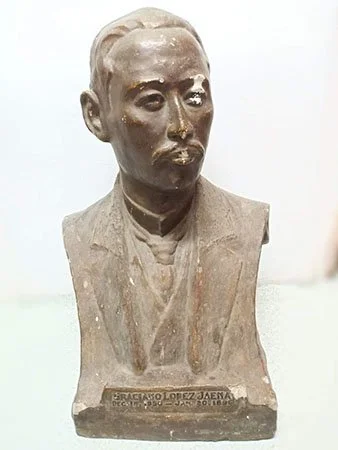
Bust of Graciano Lopez Jaena originally displayed at the Graciano Lopez Jaena College in Iloilo, currently St. Robert’s International School. (Photo courtesy of Nereo Cajilig Lujan)
Why the Bad Press?
Why the bad press when, especially as documented by Lerona, Graciano’s achievements are extraordinary? “When historians favored narratives that fit the prevailing nationalist project, Graciano’s papers, scattered across Madrid, Barcelona and Manila had become inaccessible and practically invisible,” Lerona explains. “The documents that prove his role, such as Fernando Canon’s eyewitness account, contemporary newspaper coverage, his own articles and speeches, were dispersed and difficult to access. In reality…a lot of writers and historians have just deemed these accounts irrelevant…”
Thanks to Lerona, Graciano’s footprints and his achievements are not just visible and accessible but challenge us to reflect on who gets to write the story of our nation and our nation’s heroes. “Restoring Graciano to his proper historical place reveals more than his individual accomplishments. It transforms what becomes visible about the Philippine Propaganda Movement itself, about Filipino nationalism, and about how historical memory is constructed...To rehabilitate Graciano is.... not simply to correct an injustice to one man, though that matters. It is to ask how history itself has been structured against the poor, the provincial, the unpolished.”
Lerona concludes: “(Graciano’s) dirty fingers that Alejandrino mocked became, in historical accounts, proof of unfitness. But when the records are read carefully, those dirty fingers, in fact, marked a dignified man’s struggle to make a living, a man who did not have the luxury of retreat into study or contemplation and who had to write and speak and organize while earning his bread….Reframing Graciano allows the emergence of a man who refused aesthetic respectability, would not trade his principles for patronage, and insisted on individual agency and liberty.”
Graciano died uncelebrated and unmourned in 1896 and was buried in a pauper’s grave in Barcelona. The cause of death? Arteriosclerosis, likely an effect of the tuberculosis that he contracted from years of hardship and deprivation. He did not live to see the changes he had so stirringly advocated for in his beloved homeland.
“To rehabilitate Graciano is.... not simply to correct an injustice to one man, though that matters. It is to ask how history itself has been structured against the poor, the provincial, the unpolished.”
As he stood in front of Graciano’s grave in the Montjuic cemetery in Barcelona, where Lopez Jaena was buried, what crossed Lerona’s mind? He says it was reverence and gratitude, gratitude for all the people who saw the genius of Graciano. People like Pando y Valle, publisher of Los Dos Mundos who, in 1882, so admired a speech by Graciano that he published it in full. Now we Filipinos have Emmanuel Lerona to thank, for giving us the full historical and heroic record of Graciano Lopez Jaena – dirty fingers and all. Graciano’s Dirty Fingers is a publication of the Friends of the University of the Philippines Visayas High School (UPVHS) Foundation. Inquiries about the book may be sent to books.friendsofupvhsfoundation@gmail.com. Marilynn (Meyen) Quigley is a poet and writer based in Victoria, British Columbia, Canada. She is a graduate of the University of the Philippines in Iloilo City (now the University of the Philippines in the Visayas) and was one of the editors of “Graciano’s Dirty Fingers,” together with Maria Luisa Mabunay and Francisco G. Villanueva. More articles from Meyen Quigley



No comments: