
Chess, Janis Joplin, and My Father’s Herbs
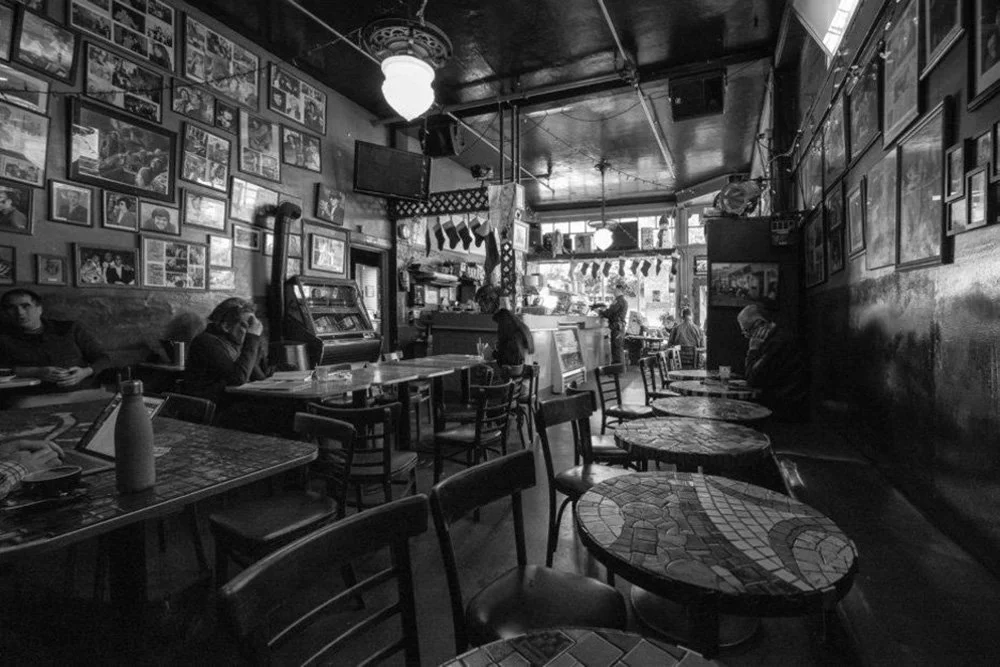
The Coffee Gallery from the bar
My father would eventually press fifty cents into my hand and tell me to get lost for a while so he could spend time with his friends. He always knew where I’d go. A short walk brought me to Grant Avenue, past Broadway’s neon and burlesque clubs, into the Coffee Gallery. By eleven, he could always find me again, bent over a chessboard in a smoky corner, the clack of pieces and the murmur of music filling the room.
The Coffee Gallery was divided into two. To the right was a small stage, a step up from the floor, where singers and poets took turns at the open mike. Folk songs and blues, jazz riffs and poems about love or politics floated out into the crowd. To the left was the Beats’ corner, heavy with smoke, where poets recited jagged lines and serious men leaned over sixty-four squares. That was my world, the world of calculation and concentration. The middle door between the two rooms led upstairs to rented spaces where drifters and musicians stayed, a reminder that art and survival shared the same roof.
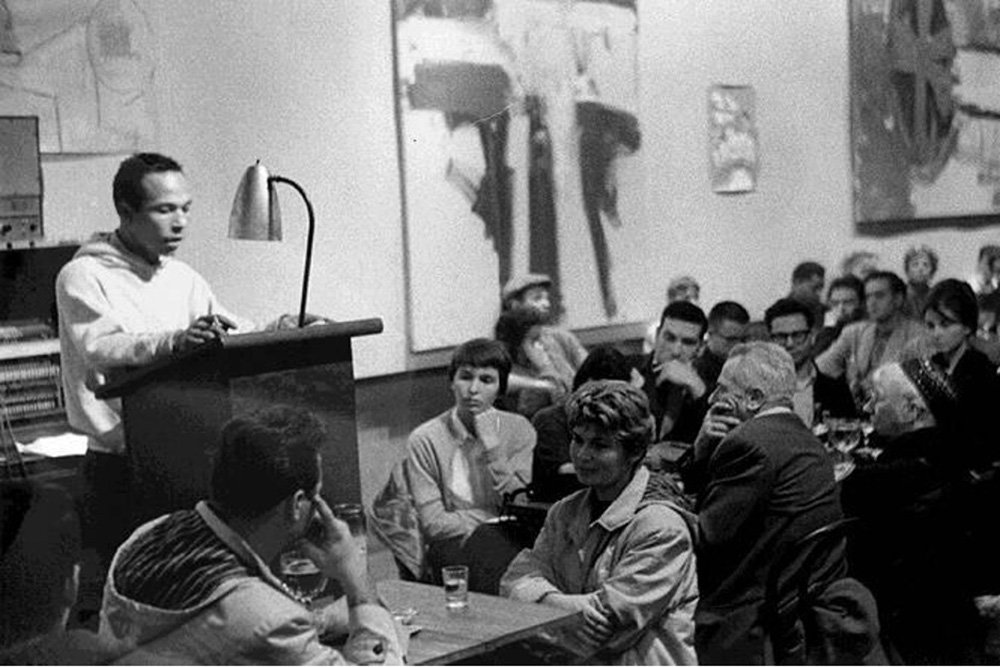
The small stage where there was always an open mike. I read my poetry here.
Smoke
I carried with me a pipe, the kind the old manongs smoked. I filled it with Filipino herbs they swore by for aching muscles and rheumatism. When I lit it, heads turned. The smoke was sharp, pungent, different. Players leaned closer. “What are you smoking?” they asked. I told them the truth. Some nodded with curiosity. One asked if I had more. Another offered me twenty dollars if I could bring extra next time. I shook my head. I wasn’t a dealer. The pipe was an inheritance, not contraband, a way of carrying my father’s world into the café.
On good nights, I walked away with twenty dollars or more in chess winnings. For a sixteen-year-old with fifty cents in his pocket at the start of the evening, that was serious money. On Saturday nights, my father would collect me near midnight, and we would return to my cousin Melvyn’s place before heading home to Salinas on Sunday. The weekdays brought school and chores, but those weekends at North Beach felt like another life altogether.
By March of 1963, the Coffee Gallery gave me something more. One night, deep in a middle game, I heard a voice split the air. It was raw, jagged, the kind of blues that felt torn out of the body. A young woman stood on stage, eyes closed, hair wild, her whole frame shaking with the song. When her set ended, she didn’t disappear. She wandered around the room and stopped at my table. She tilted her head at the pipe.
“What are you smoking?” she asked.
“Filipino medicinal herbs,” I said. “The manongs use it for rheumatism.”
She laughed, leaned closer, and said, “Smells like Texas herbal medicine. May I take a puff?”
Janis
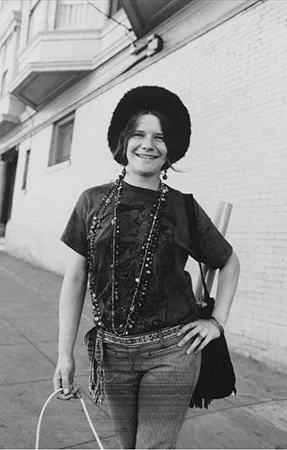
Janis Joplin
She drew from the pipe, exhaled, and handed it back with a grin. That was how I first met Janis Joplin.
By the fall of 1963, Melvyn and I realized the herbs had value beyond the boarding houses. What was ordinary to us was exotic to the Beats and musicians. Quietly, carefully, we began selling small pouches. By the end of the week, we each made about a hundred dollars. It was good money, though we never thought of ourselves as dealers. Janis was among those curious enough to try. In those nights, the economy of North Beach was its own ecosystem: coffee and poetry, guitars, and protest songs, chess games and the smoke of our herbs.
As the years turned, the music shifted. Protest songs about civil rights and Vietnam began to fill the stage. Folk sharpened its edge, jazz grew louder, and electric guitars buzzed where once only acoustic strums had been heard. The Coffee Gallery remained smoky and alive, but the sixties were pressing in, reshaping everything. Janis drifted in and out, always restless, sometimes gone for weeks before returning with new songs. We remained friends, talking after her sets, laughing about the smoke, caught between the pull of the city and the inevitability of change.
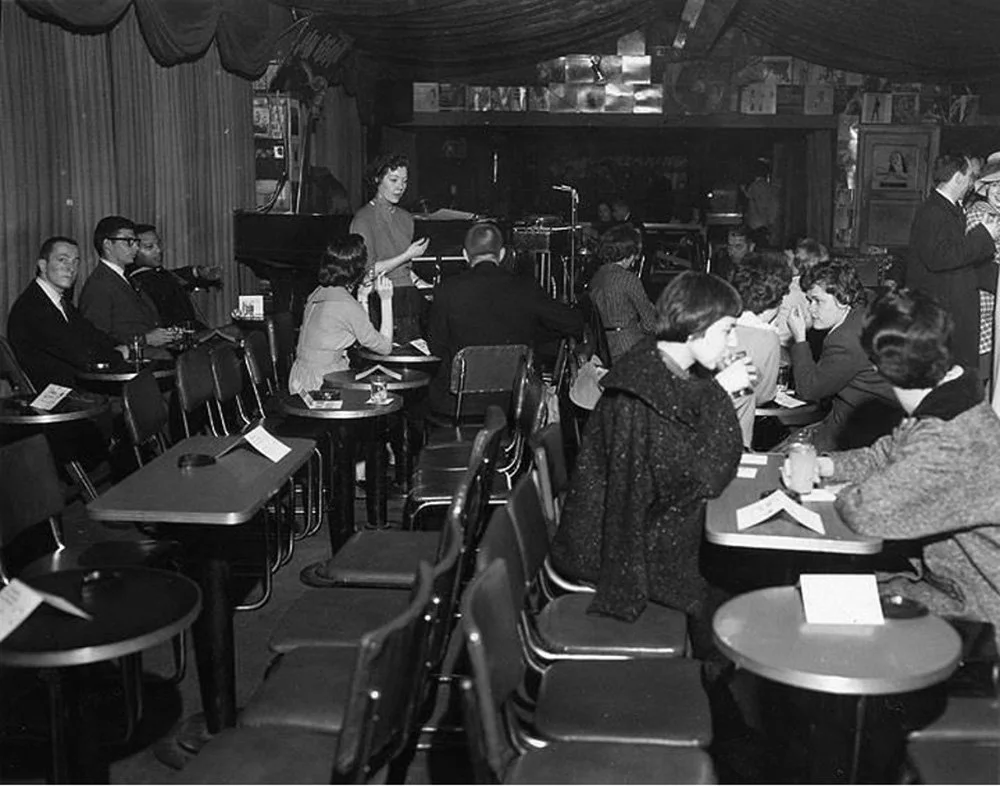
Some say the woman in black dress is rare photo of Janis out of her hippie/blues mode.
Vietnam and Monterey Pop
By the fall of 1965, I could no longer linger in North Beach. I left for the Marines, carrying with me memories of chess games, Janis’ grin, and the smoke of my father’s herbs. Vietnam came soon enough, and it left its marks.
In June of 1967, I returned, carrying the war inside me. On leave, I returned to Salinas, grateful for my family, trying to pretend I was just a son again. But the world had shifted, and so had I. With my Marine buddies, I attended the Monterey Pop Festival. We had box seats from the Naval Postgraduate School recreation center, eight seats to the right of the stage. Cameras hung around my neck — two Nikons, one wide, one telephoto, loaded with Tri-X 400 film pushed to 1600 ASA. I wasn’t just there to listen. I was there to document history.
My press card from the Philippines Mail earned me a festival press pass. It opened doors — backstage, side stage, the pit. I crouched before Hendrix’s flaming guitar, stood on the side stage as Otis Redding shook the crowd, and moved backstage as Janis came off after her set with Big Brother and the Holding Company. She spotted me in the crush and smiled. For her, I wasn’t another face in the press scrum. I was a boy she remembered from the Coffee Gallery, the kid at the chessboard with the odd pipe. For me, it was a circle closing: from a smoky café in 1963 to a world stage in 1967.
We skipped Ravi Shankar’s Sunday set. Four hours of sitar wasn’t for us. My ears were still ringing from Hendrix’s guitar and Janis’ scream. The next morning, I boarded a flight out of Monterey Airport, heading to Los Angeles and then east. My orders sent me to Fort Holabird in Baltimore for counterintelligence and interrogation courses. I told myself it was a way forward, but the truth was more straightforward: I needed to burn away memories. When I came back from Vietnam, I thought someone would be waiting. Instead, there was no one. My friend was gone, and in the silence that followed, the Corps was all I had left. So, I chose to stay in, to bury myself in work and discipline until the pain dulled.
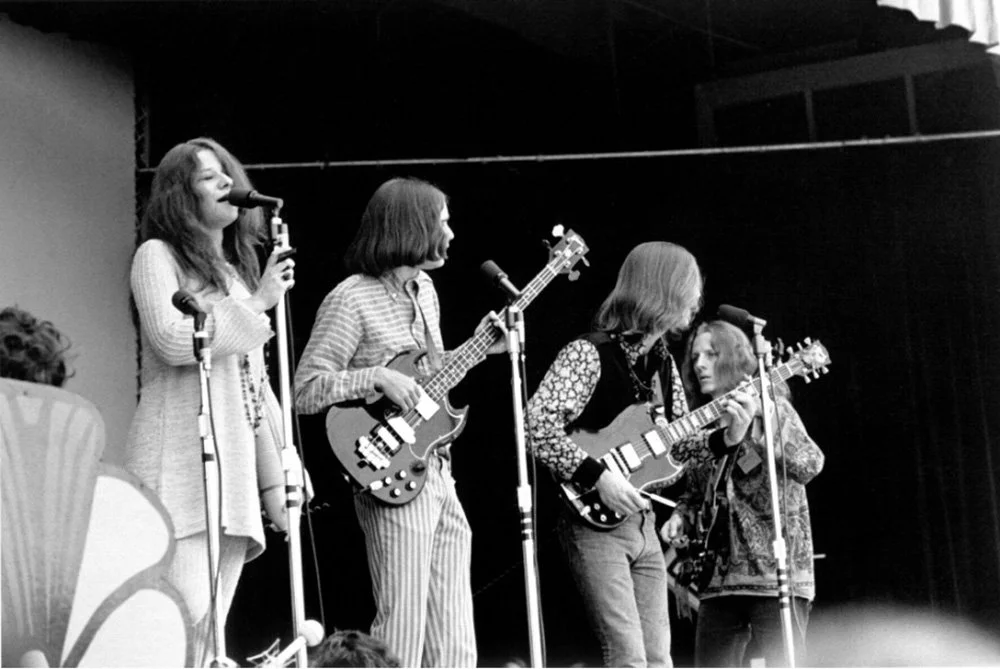
Into full bloom rock star. Summer of Love back from Vietnam in time to witness the Monterey Pop Festival
Cousin Melvyn
My cousin Melvyn had his own struggles. One day, he wore his uniform to the store in San Francisco, and strangers jeered at him, calling him a baby killer. That cut deep. Soon after, he left for embassy guard duty, first in Moscow, then in Paris. From Haight and Central to the capitals of the Cold War, his path took him far from the streets we had once walked together.
For me, the next step came in June 1968. I returned to Monterey, this time not for music but for study. The Defense Language Institute became my post, where I spent a year drilling in Chinese Mandarin and taking a short course in Vietnamese. From June 1968 to June 1969, I lived in that rhythm — tones and characters, endless repetition, uniform pressed, preparing for a different kind of war. It was strange to be back in Monterey, the same city where, only a year earlier, I had crouched in the pit, photographing Hendrix and Janis. Now I sat at a desk, parsing sentences, repeating sounds until they felt natural in my mouth. The same streets carried two lives — guitars for some, grammar drills for others.
That summer, I came home often to Salinas. My father’s house became a gathering place for young people, PACE students from San Francisco State who needed a place to stay. They were full of energy, fire, and questions about what it meant to be Filipino American. Their laughter and arguments reminded me of my own restless days at sixteen, leaning over chessboards in North Beach. For a while, I wasn’t just a Marine. I was a bridge, standing between my father’s generation of manongs, my own service in Vietnam, and these students who wanted to build something new.
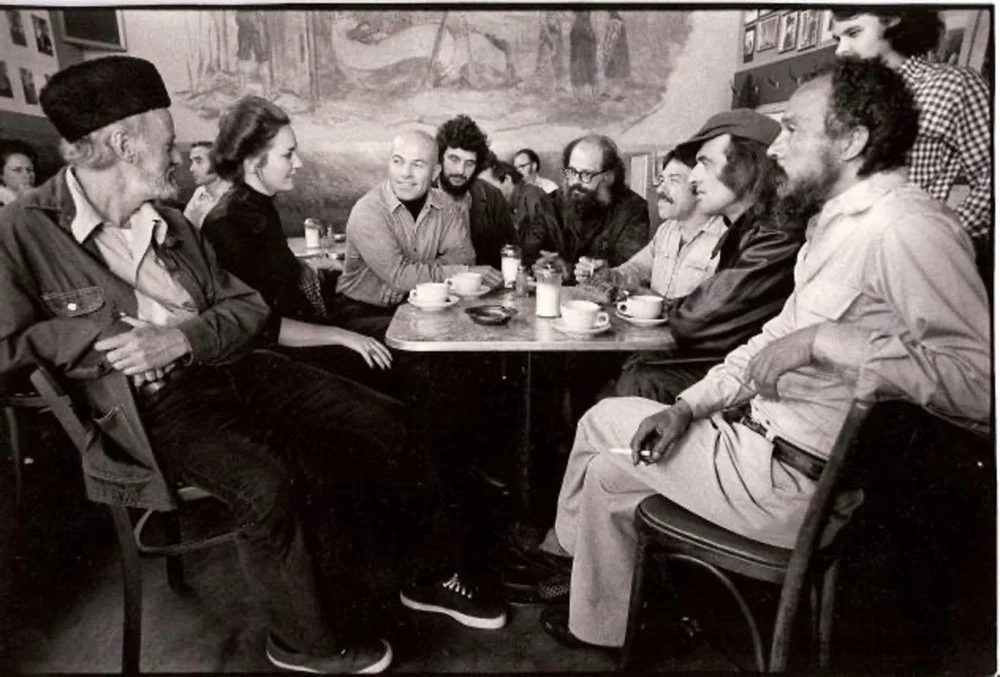
The crowd at the Coffee Gallery
Vietnam Again
I spent months hanging out with friends, holding on to the ordinary rhythms of life while I could. But in June 1969, orders came again. The schooling was done. I left for Vietnam a second time, this time not just another Marine but a Sergeant, twenty-three years old, carrying not only a rifle but new languages in my head, tools for another kind of war. The second tour felt heavier because I knew what I was walking into and what I was leaving behind.
Seven years had passed since the spring of 1962, when I was just a sixteen-year-old kid walking into the Coffee Gallery with fifty cents in my pocket, hoping to find a chess game. In those years, I had won twenty-dollar pots on Grant Avenue, sold herbs with my cousin Melvyn, smoked with Janis Joplin, marched through Vietnam, photographed Monterey Pop, trained at Holabird, studied Mandarin at DLI, hosted PACE students at my father’s home, and gone back to war as a Sergeant.
The Coffee Gallery is gone now. Janis is long gone, too. The Haight has become a postcard version of itself; the manongs’ restaurants on Kearny mostly disappeared
The streets of San Francisco — Kearny, Broadway, Grant, Haight, Stanyan — had all marked me. The music of the city — folk, blues, jazz, protest songs, and the roar of rock — had carried me along. But the Marines also shaped me, instilling discipline and demanding that I bear my losses without complaint. My cousin had gone from jeers on the street to serving as an embassy guard in Moscow and Paris. I had gone from a smoky chess table to the jungles of Vietnam, carrying both memory and duty on my shoulders.
The Coffee Gallery is gone now. Janis is long gone, too. The Haight has become a postcard version of itself; the manongs’ restaurants on Kearny mostly disappeared. But I carry it all still. In memory, the board is set, the smoke curls upward, and the music carries across the years — the journey of a boy who was sixteen in North Beach and a Marine Sergeant of twenty-three, heading back to war.
Alex S. Fabros, Jr. is a retired Philippine American Military History professor.
More articles from Alex Fabros, Jr.



No comments: