
‘Holesome’ Low-Carb Treats Selling Like Hotcakes
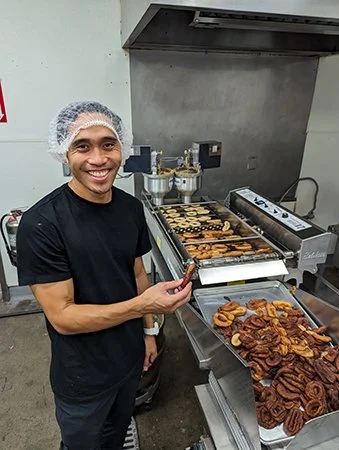
Kristoffer Quiaoit at the donut factory experimenting to find the recipe that works. It took years to get the recipe right.
Dunkin’ Donuts operates over 14,000 stores all over the world. A Dunkin’ glazed donut has 240 calories, 13 grams of sugar, and 33 grams of carbohydrates. While the product also contains 4 grams of protein and zero trans fats, Dunkin’ hasn’t provoked the American Heart Association by marketing its donuts as a health food, despite a large presence on the web of self-identified “Dunkin’ donut addicts” who might welcome a Planck length of vindication, however spurious. For the record, donut addiction isn’t listed in the DSM (Diagnostic and Statistical Manual of Mental Disorders).
Donuts are, by nature, tradition, and definition, bad for you. A company that argues its donuts are healthier than Dunkin’ donuts is stepping into an empty ring. Nobody would contest such an undeniable claim. Nonetheless, this is the fight Good Journey Donuts has picked, and its donuts are selling like hotcakes.
Kristoffer Quiaoit, 39, and his business partner, Helen Ma, founded Good Journey Donuts in Anaheim, California. Before the business started in 2021, he never associated donuts with a healthy diet.
“I love donuts!” declares Quiaoit. “Anytime I see a Krispy Kreme hot light turned on, I can’t control myself. I gotta grab a donut. I know it’s full of sugar and junk, but it brings back memories. When we (Kristoffer and his two younger siblings) went to church with my parents, once it was over, we’d say, let’s go get some donuts.”
The donut industry was in decline before Maria Teresa and Enrique Quiaoit used maple bars and crullers to lure their children to the pews. Krispy Kreme underwent a restructuring in 2005 and hasn’t seen a return of the lines around the block at grand openings. Hostess Brands filed for bankruptcy in 2012 before it was revived by private equity and nostalgia for Twinkies and Ding Dongs.
“Hey, why don’t we create a low-carb donut?” asked Ma’s husband. The owners of two donut shops in Southern California happened to be speaking to a veteran of the TV show Shark Tank.
In 2018, Quiaoit and his previous business partner appeared on Shark Tank to pitch their idea for a healthy cookie company named Nui. Before their television debut, their Kickstarter campaign had raised $100,000, but they were still scooping cookie dough in Quiaoit’s mother’s kitchen.

Kristoffer Quiaoit and former business partner, Victor Macias pitching on Shark Tank for his previous company Nui.
“It was a really cool experience,” Quiaoit says of their Shark Tank appearance. “My cofounder is Mexican American. We got to share our experience of being children of immigrants.”
Philippine Roots
“When my mom emigrated here,” recalls Quiaoit of Maria Teresa, who grew up in Davao and graduated from the University of Santo Tomas, “she didn’t want English to be a barrier to advancing her career, so she would carry a thesaurus and dictionary around. She started out working as a clerk at the old El Toro Air Force Base in Irvine.”
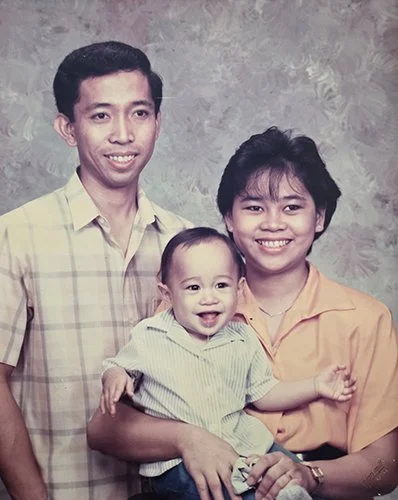
A picture from 1986 of Kristoffer Quiaoit as a baby with his parents Enrique Quiaoit and Maria Teresa Quiaoit. Kristoffer's parents immigrated from the Philippines in 1985 to Southern California, where they would raise their 3 children.
Enrique Quiaoit came from Fort Bonifacio and went to the University of the Philippines. “My dad had four jobs,” remembers the young entrepreneur. “He had a newspaper route, worked at a gas station, and stocked shelves at two different stores.”
The eldest son takes pride in his parents’ rise from humble beginnings. Enrique works for the Orange County District Attorney’s Office, and Maria Teresa is an Assistant Chief in the Los Angeles County Fire Department. “She’s like five feet tall and is telling these six-foot men what to do,” gushes Quiaoit.
Indulging Every Dream
Kristoffer Quiaoit has an Economics degree from the University of California at Irvine. Nui was his second business venture and his third career change. After college, he embarked on a teaching career. It was the start of the 2008 recession. He couldn’t find a teaching job, so he started a tutoring business. “Our students were on the spectrum or had dyslexia. We helped them gain confidence and develop their skills in math and sciences.”
Quiaoit was too young for a midlife crisis when he shifted from tutoring to donuts. The two fields have nothing in common with each other or the third profession he explored. “I had grown up wanting to play basketball,” remembers the 5’8” guard. “I had to push off that dream when I went to college. After college, I realized that I’m not going to be athletic much longer, and I didn’t want to grow old regretting that I didn’t give it a shot.
“That’s when I took the leap and moved to the Philippines.” A priest friend of his father allowed Quiaoit to stay in his seminary for $100 per month. With a roof over his head, savings for food, and an agent, Quiaoit earned a spot on the practice squad of the Barangay Ginebra San Miguel professional basketball team.
His basketball career never soared, but he has fond memories of jeepney rides. He returned home without regrets of what could have been. “I know I gave it my all, and it didn’t work out.” He could not have pursued basketball if he had procrastinated. “It would have been harder if I was married.
“Now, I have kids,” he says with a wistful grin. He and his wife, Jessica, have a six-year-old son and a four-year-old daughter. Jessica is Mexican American, and every day he’s amazed by the similarities between Filipino and Mexican families.
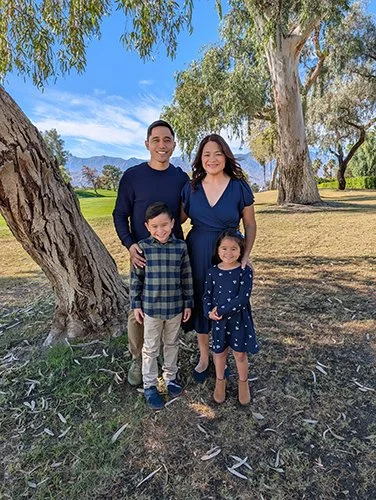
Kristoffer Quiaoit, Jessica Quiaoit and their two kids, Elio and Solana.
Too Big to Succeed
Nui flourished after his Shark Tank appearance, but the cookie company became a victim of its own success. His cookies followed a paleo cookie recipe. “We swapped out some of the ingredients that would raise your blood sugar with ingredients like almond flour and a low-carb sweetener.
“At the time of Shark Tank, we were still scooping cookie dough by hand. We were ready to use big equipment that could spit out cookies in seconds.” Automation required a compromise. “We had to change our recipe. We found out that the new recipe was no longer shelf-stable,” he says of the ability to last from factory to market.
“After we sent out a $300,000 batch of cookies, a customer informed us that he got one of our cookies, but it had mold on it. We saw a picture of a cookie with white fuzz on it.” He takes a deep breath and adds, “Soon we got more emails and messages on Instagram and Facebook. That’s when we started issuing refunds. We didn’t have the right insurance to cover the loss.”
Calls from creditors mounted until the business partners were left with no other choice but to declare Chapter 11 bankruptcy. Quiaoit and his young family moved in with an uncle and aunt in Cerritos until they could save for their next venture.
Giving Donuts a Makeover
Low-carb donuts are more Holy Grail than original idea. “People didn’t try making them because they knew they would be hard to make. They thought anything they created wouldn’t taste great,” Quiaoit says of the universal challenge. “We focused on the taste and texture for over a year.
“We suffered a lot of failed experiments. Donuts were exploding in the fryer because they weren’t holding together. But we kept working at it until we created a donut that tastes very close to a cake donut that you get at your corner donut shop.”
Quiaoit reports that the company is “doing six figures in volume.” Their low-carb donuts come in two flavors: Cha-Cha Horchata and Choc-a-lot.
Most importantly, these sweet donuts are gluten-free, keto-friendly, and contain 17 grams of fiber and only 2 grams of sugar and 3 grams of net carbs.
The name Good Journey reflects Quiaoit’s philosophy that sustained him from the basketball court to the kitchen to the factory floor. “When my last company was going downhill, I made it my intention to enjoy the journey and to have gratitude for whatever’s happening at any given time,” he relates. “One of the company values of Good Journey is to celebrate the journey. Our team celebrates where we were before, where we are now, and where we’re going.”
Good Journey is growing, but at a manageable pace. Quiaoit reports that the company is “doing six figures in volume.” Their low-carb donuts come in two flavors: Cha-Cha Horchata and Choc-a-lot. Donuts are sold online by the dozen with individual wrapping and are shipped with ice packs. Customers are advised to keep them refrigerated until dessert time.
Good Journey donuts are also available at Berkeley Bowl Marketplace in Northern California and at Lassens locations in San Luis Obispo and throughout Southern California.
An ube-flavored donut isn’t an immediate priority. Quiaoit reentered the cookie trade with a Soft Churro Cookie and is about to release a chocolate chip cookie. A confetti cake cookie is in the works.
A Baker Who Croons
Now comes the question by which every Filipino is measured. Can he sing?
“Yes,” he answers without a beat. “I used to sing in school choir and then in a church choir. I sang to my wife for the first dance at our wedding. It was an acoustic version of ‘Latch’ by Sam Smith.”
Kristoffer Quiaoit is as authentic as his donuts.
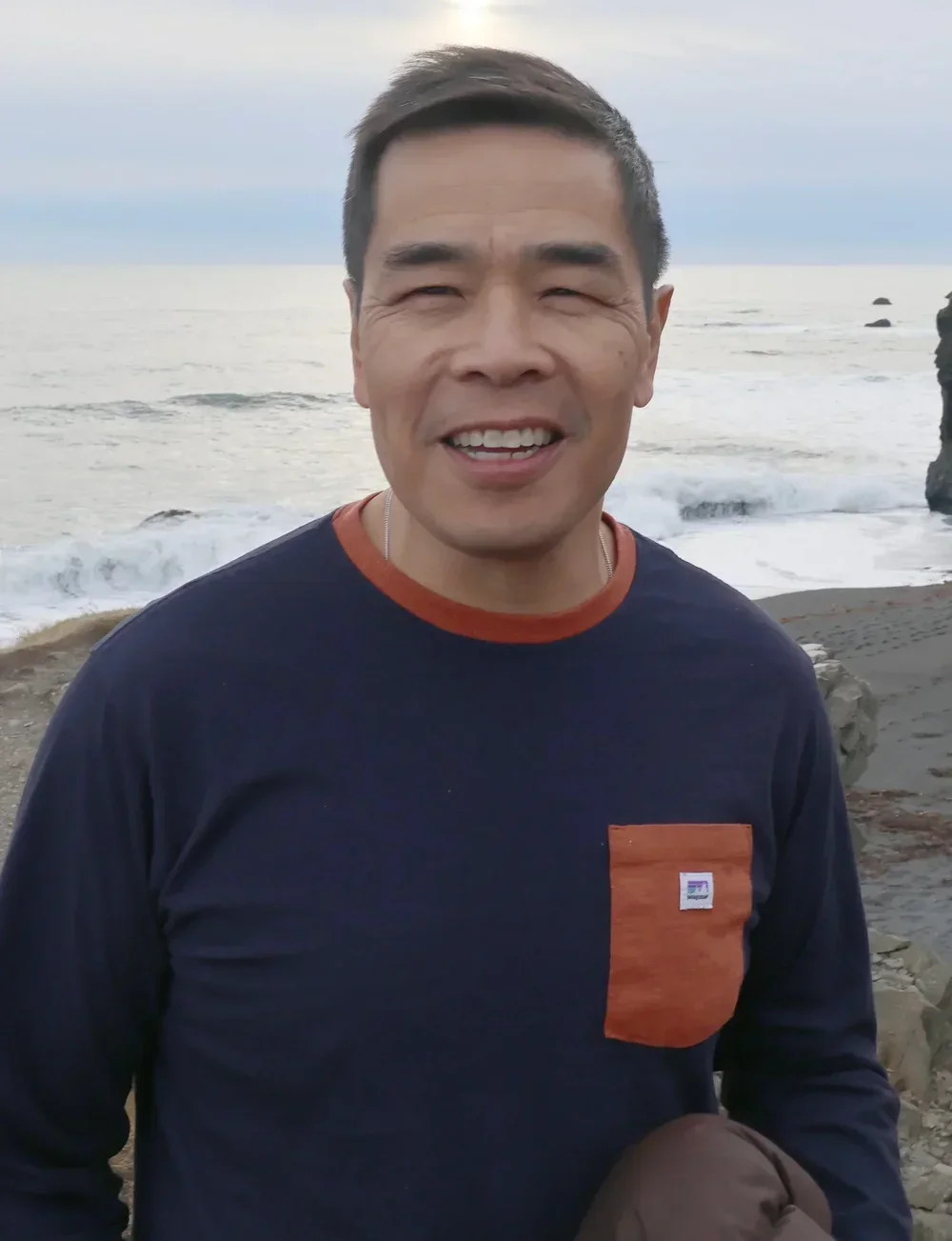
Anthony Maddela is based in Los Angeles. He and his wife, Susan, like to travel.
More articles from Anthony Maddela



No comments: