
High Drama in a Low Country: Duterte Watch in The Hague
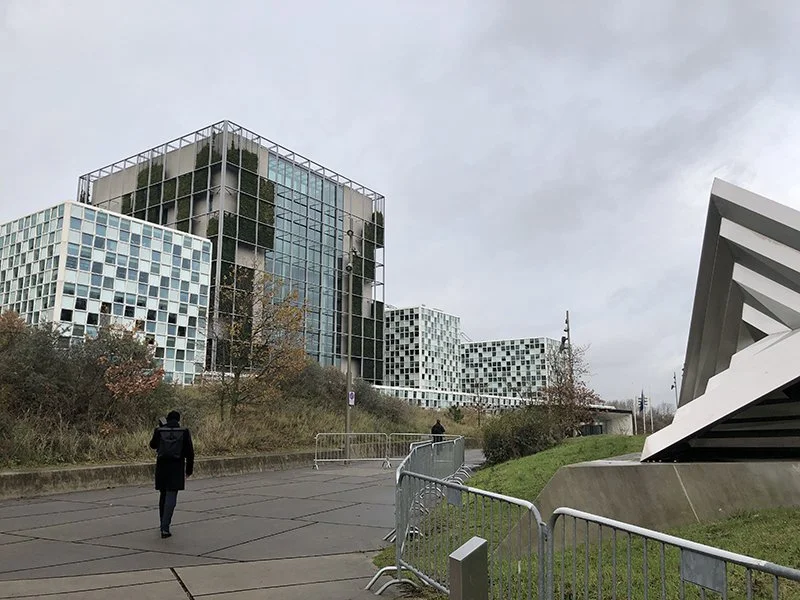
The International Criminal Court, a prominent cubist building in The Hague where the case against former President Duterte is being held. (Photo by Criselda Yabes)
On November 28, the ICC Appeals Chamber unanimously rejected the defense’s plea for Duterte’s temporary release—something close to bail—on three grounds: that he was a flight risk, that no third country would guarantee keeping him in custody, and that there was no urgent humanitarian issue.
For about 35 minutes, Judge Luz del Carmen Ibañez Carranza of Peru read the decision in English (the other official language is French, as it was during Duterte’s first appearance). She delivered it in a straightforward manner, emphasizing the key points where the defense “failed” to show, demonstrate, and substantiate why Duterte should be granted provisional freedom at this stage.
The glass panel sealing off the public gallery—with its balcony view of the court, three judges in blue robes, and lawyers in black robes seated at desks with screens and earphones—gave a clinical atmosphere to a high-profile case that many Filipinos once thought would never happen.
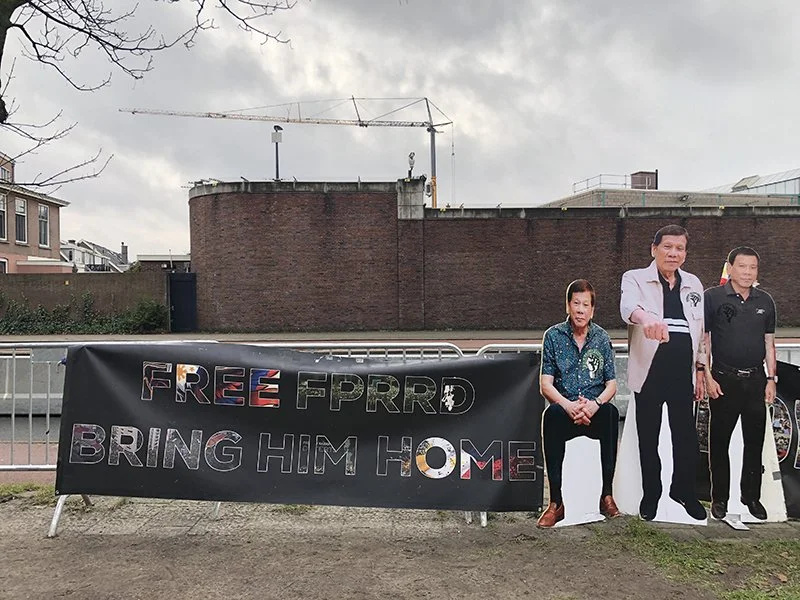
Cut-out cardboards of Duterte at the court entrance on the day judges denied his defense lawyer’s request for a temporary release. (Photo by Criselda Yabes)
Future Reckoning
Here in The Hague, the international court may hold the future of a country’s reckoning with impunity and political violence.
Early this year, on March 11, Duterte was whisked off on a chartered flight to the Netherlands, a swift arrest once unimaginable for a man who wielded power. He is being made to answer for his brutal war on drugs when he was president from 2016 to 2022, with rights groups claiming as many as 30,000 victims.

Salvador Mediaidea and former Philippine President Rodrigo Duterte on the plane that took him to the Hague on March 11, 2025 (Source: Senator Bong Go’s facebook page)
Duterte appeared in court through a video link three days later, wearing a light-blue suit, his eyes nearly shut, his breathing rapid—and that was the last time he was seen in public, so to speak. Later that month, he turned 80.
A hearing on the confirmation of charges—the equivalent of an arraignment—had been set for September 23 to 26 but was postponed largely due to his lawyer’s appeals.
A British-Israeli Defense Lawyer
Hired by the Duterte family after the strongman’s arrest, British-Israeli lawyer Nicolas Kaufman—known for handling high-profile ICC cases—subsequently filed appeals to get Duterte out of the ICC detention center, located less than two kilometers from the court’s imposing modern cubist architecture.

Nicolas Kaufman (Source: Wikipedia)
The Pre-Trial Chamber overseeing Duterte’s case had already rejected Kaufman’s demand for an “interim release,” an innocuous-sounding term that could have serious political and legal consequences. Duterte is currently the only former head of state from Asia under detention.
The chamber believed Duterte still carried powerful influence back home and was not convinced he would refrain from escaping, sowing trouble, or threatening witnesses. His daughter, Sara Duterte, is the country’s vice-president, and he had just won a mayoral seat in his hometown of Davao in the midterm local elections, a post he held before becoming president. And would a third country even be willing to take him while guaranteeing he would not skip trial
Interim Release Nixed
No country has yet come forward, officially, though sources have floated a few possibilities among those Sara visited in recent months. As far as the court is concerned, the demand for interim release now appears moot.
Kaufman elevated the motion to the Appeals Chamber, hence the judgment hearing on the morning of November 28. Duterte sat without expression, staring at the screen and listening to the judge uphold the Pre-Trial Chamber’s earlier conclusions.
Above him, in the public gallery—where the audience was smaller than expected—sat some Duterte supporters, including his grandson Omar, a congressman in the Philippine Lower House. There was no outburst, no verbal reaction. A few wept. And the turn of events rolled over once again.
Outside, Duterte’s former presidential spokesman Harry Roque was holding court among supporters, interviewing them for his Facebook livestream and asking how they felt about the decision. Roque has been a headache for the Dutch government, which tried to send him back to Vienna, Austria—his first point of entry before crossing European borders to seek asylum in the Netherlands. The Philippines has canceled his passport, and a warrant for human trafficking awaits him in a local court
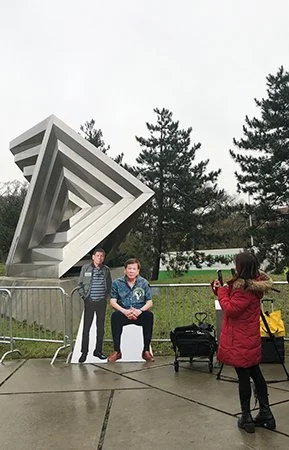
Duterte followers have called this side of the toad ‘Duterte Street’ where they hold gatherings across the side building of the detention center not far from the ICC building. (Photo by Criselda Yabes)
From Human Rights Lawyer to Loyalist
Roque began as a human rights lawyer before turning into a Duterte loyalist. He attempted to present himself as Duterte’s counsel until Sara Duterte tapped Kaufman—whose reputation matches his hefty fees—as defense lawyer.

Harry Roque livestreaming from the Netherlands (Source: Harry Roque’s Facebook page)
In September, the ICC’s charge sheet accused Duterte of crimes against humanity, with prosecutors laying down three counts: Duterte as “indirect co-perpetrator” for alleged involvement in killings when he was Davao mayor; as president for murders of “high-value targets” nationwide; and for murders and attempted murders during the notorious tokhangvillage-clearance operations.
The bid for temporary freedom ends at the Appeals Chamber, but that does not mean Kaufman will not seek other avenues in what appears to be a strategy to delay the actual trial. Although the pre-trial hearing has been postponed—the confirmation of charges may be due early next year if the court decides—Duterte’s stay in prison is now a waiting game. If he dies, how will it affect the political climate in his home country?
Questioning Medical Experts
Kaufman has also questioned the court’s selection of independent medical experts, who must submit their assessment of Duterte’s health by December 5. He claims Duterte is suffering from “cognitive impairment”—without giving details—such that he may not be fit to stand trial.
The public might have witnessed the former president’s condition in person if he had appeared in court as many expected. Duterte receives regular, if not daily, family visits from siblings taking turns flying to the Netherlands.
That alone shows the Dutertes’ resources—their trips across oceans seeming like jaunts to popular Cubao shopping malls in Manila, said Kristina Conti, the ICC’s assistant to the prosecution counsel and lawyer for victims of the anti-drug war.
From these visits, speculation about his health often circulates in the news media and propaganda blogs the moment a family member exits the detention center. The ICC prohibits visitors from discussing the case—a rule Duterte’s common-law wife Honeylet Avanceña violated; she is no longer allowed to visit.
Heard on the Grapevine
Word has it that Duterte has lost much weight, that he has no appetite—“walang gana” were the exact words—for the Western flavors of his daily meals. But even this is not enough to convince the court to grant leniency on humanitarian grounds. As Conti noted, ICC facilities have a “high standard” of physical and mental care for detainees.
To Dutch sensibilities, the attention drawn by the ICC’s controversial Filipino prisoner is a bit much. The upscale neighborhood in front of the penitentiary has complained about the noise and nuisance from Filipino supporters gathering outside. The loyalists have since been moved to a street facing the side of the prison’s brick walls.
Duterte appeared in court through a video link three days later, wearing a light-blue suit, his eyes nearly shut, his breathing rapid—and that was the last time he was seen in public.
About a dozen huddled around a picnic table hours after the November 28 hearing—a typical Filipino gathering around food even in the cold autumn air. A lady offered me a slice of banana cake. I could have tasted the turon (fried banana roll), but other journalists hovered carefully; there has been a tug-of-war between the press and the hardcore followers. The theatrics, and the crowds, have since diminished.
When we walked to the bench outside the detention center, where other journalists were waiting for Duterte’s grandson to finish his visit, a loyalist blogger followed and blatantly filmed us on her phone as we conversed briefly. Back home, families of victims rejoiced upon hearing the court’s ruling. Two days later, Manila was on the brink of massive rallies denouncing widespread corruption in flood-control programs.
Criselda Yabes is a writer and journalist who has written about a dozen books, some of them on the military and Mindanao.
She now lives in northeast France and comes home to the Philippines when life calls for it.
More articles from Criselda Yabes



No comments: